
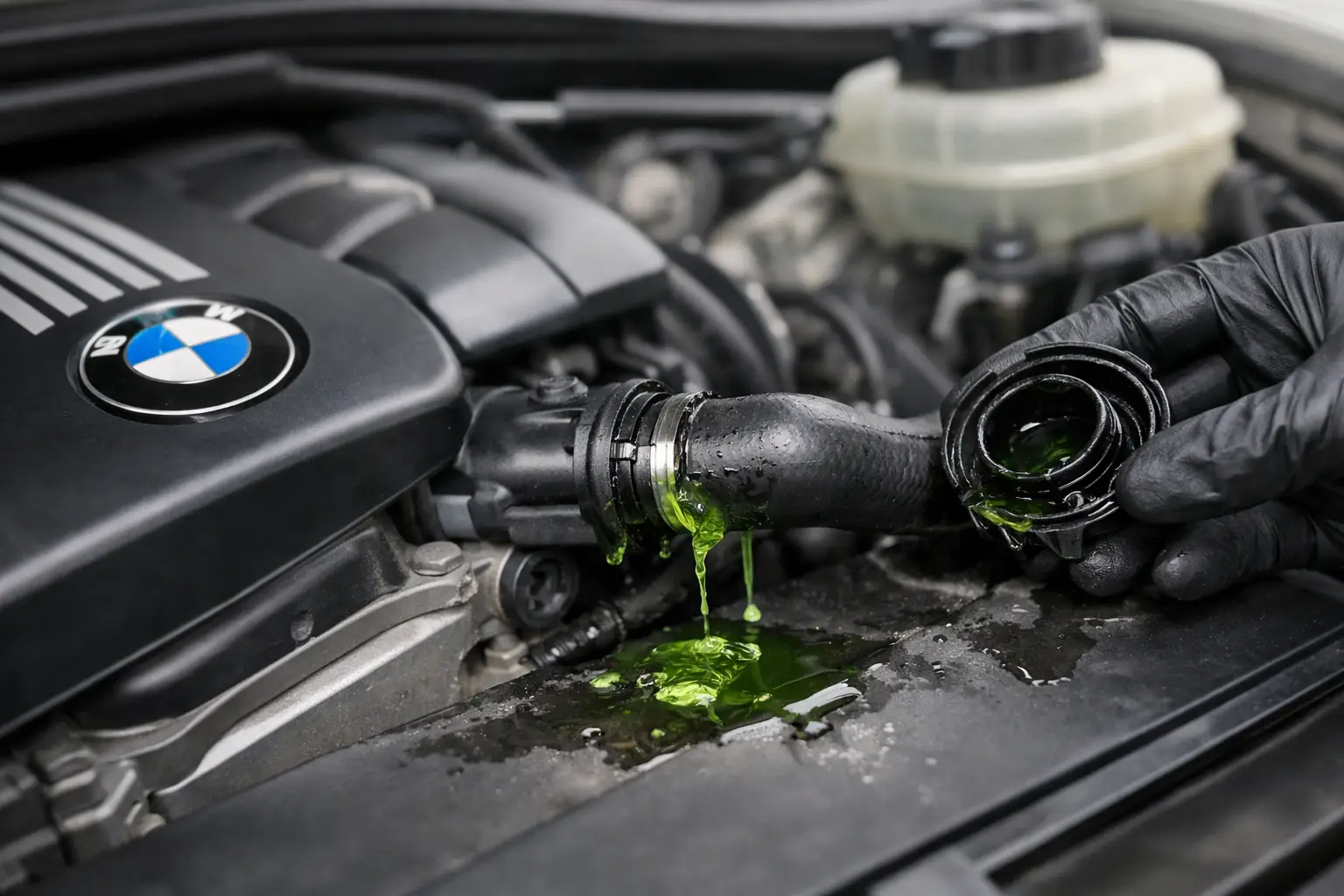
A BMW coolant leak example often starts quietly: a sweet smell after parking, a small puddle near the front of the vehicle, or a low-coolant message that disappears after topping off the reservoir. For a BMW owner, those early signs deserve attention. Cooling systems operate under pressure, and a minor seep can become an overheating concern with little warning.
The goal is not to panic at every drop of fluid. It is to identify where the coolant is escaping, determine whether other cooling-system parts are affected, and make a repair that protects the engine and the driving experience you expect from your BMW.
A BMW coolant leak example from a common scenario
Consider a BMW 328i that arrives with an intermittent low-coolant warning. The owner has not seen steam or an overheating gauge, and the vehicle still drives normally. They noticed a faint sweet odor after a longer commute and found dried white-blue residue around the expansion tank area.
A visual inspection may reveal coolant staining at a plastic hose connection or along the seam of the expansion tank. After the system is pressure-tested, a slow leak becomes visible at the connection. The leak is small when the engine is cold, but it opens more under operating pressure and heat.
This is a useful BMW coolant leak example because it shows why a quick top-off is not a repair. The tank, hose, fitting, clamp, and nearby components all need to be checked. Plastic and rubber cooling-system parts age through repeated heat cycles. When one part is leaking, another part may be close to the same stage of wear.
The appropriate repair depends on the findings. A damaged hose or connector may be replaced on its own. If the expansion tank is brittle, cracked, or showing seepage at its seams, replacement is the more reliable path. A specialist should also refill the system with the correct BMW-approved coolant mixture and properly bleed air from the system. Trapped air can cause inconsistent cabin heat, temperature concerns, and repeat warnings.
Why BMW coolant leaks need precise diagnosis
BMW cooling systems are engineered for efficient temperature control, but they have several possible leak points. The source is not always visible from above, especially when coolant has traveled along a hose, under an engine cover, or onto an underbody shield before dripping to the ground.
The expansion tank, coolant hoses, radiator connections, water pump, thermostat housing, and oil filter housing area can all be involved, depending on the engine and model. Some leaks only appear after the system builds pressure. Others leave residue without producing an active drip during a short visit.
That is why diagnosis should go beyond looking for a wet spot. A proper inspection often includes a cooling-system pressure test, a check for dried coolant residue, verification of coolant level and condition, and an assessment of related components around the leak. Manufacturer-grade diagnostic equipment can also help identify stored fault information or cooling-system behavior that supports the repair decision.
There is a cost benefit to this approach. Replacing a visible part without confirming the true source can leave the original issue unresolved. On the other hand, replacing every nearby cooling component without evidence is not honest service. The right recommendation is based on the vehicle’s condition, age, mileage, service history, and what testing actually shows.
Warning signs that should not wait
A low-coolant warning is the most direct sign, but it is not the only one. A sweet smell around the engine bay, dried crusty residue near hoses or the reservoir, a damp spot under the front of the vehicle, or weak cabin heat can all point to a cooling-system concern.
Pay close attention if your BMW displays an overheating warning, the temperature begins rising beyond normal, steam appears from under the hood, or the heater suddenly blows cold while the engine is hot. In those situations, pull over safely and turn the engine off. Continuing to drive an overheating BMW can turn a manageable cooling repair into much more extensive engine damage.
Coolant color alone is not a reliable diagnostic tool. Coolant can look different depending on its age, lighting, residue, or a prior service. More importantly, different formulas should not be mixed casually. Using the correct coolant specification matters for corrosion protection and long-term cooling-system health.
Can you drive with a small coolant leak?
It depends on the severity of the leak and whether the engine is maintaining normal operating temperature. A very minor seep may not create an immediate emergency, but it is still not something to monitor indefinitely. Coolant can be lost faster under highway driving, hot weather, stop-and-go traffic, or heavy engine load.
If the level is repeatedly dropping, schedule service soon rather than relying on frequent top-offs. Topping off may temporarily prevent a warning, but it does not restore the system’s ability to hold pressure. It can also make it harder to notice when the leak worsens.
Never open the coolant reservoir cap while the engine is hot. The cooling system is pressurized, and hot coolant can cause serious burns. If you need to check the level, let the vehicle cool completely and follow the instructions in your owner’s manual.
What a quality repair visit should look like
A BMW cooling repair should begin with questions, not assumptions. When did the warning first appear? Is there a smell after driving? Has coolant been added recently? Does the concern occur only in cold weather, during longer trips, or after the vehicle sits overnight? Those details help narrow the diagnostic process.
At Wizard Werks, our technicians inspect the source of the leak and explain what they find in clear terms. If a hose connection is the problem, you should know why it failed and whether related parts show meaningful signs of deterioration. If the concern points to a water pump, thermostat housing, or another component that is harder to access, the repair recommendation should account for labor overlap and the condition of surrounding parts.
There is no one replacement schedule that applies to every BMW. A newer vehicle with a damaged fitting may need a focused repair. An older, higher-mileage BMW with several original plastic cooling components may benefit from a broader preventive plan while the system is already open. The difference is transparency: you should understand what is necessary now, what can be monitored, and why.
How to reduce the chance of a repeat leak
Regular maintenance gives technicians a chance to spot aging hoses, residue, and reservoir deterioration before you are stranded. It also helps to avoid ignoring small warnings, use the correct coolant when service is needed, and keep an eye on the area where you park.
Your BMW does not need guesswork or a generic repair approach. A small coolant leak is often straightforward when diagnosed early, and prompt specialist care helps keep a minor warning from interrupting the next commute, weekend drive, or trip out of the northwest suburbs.