
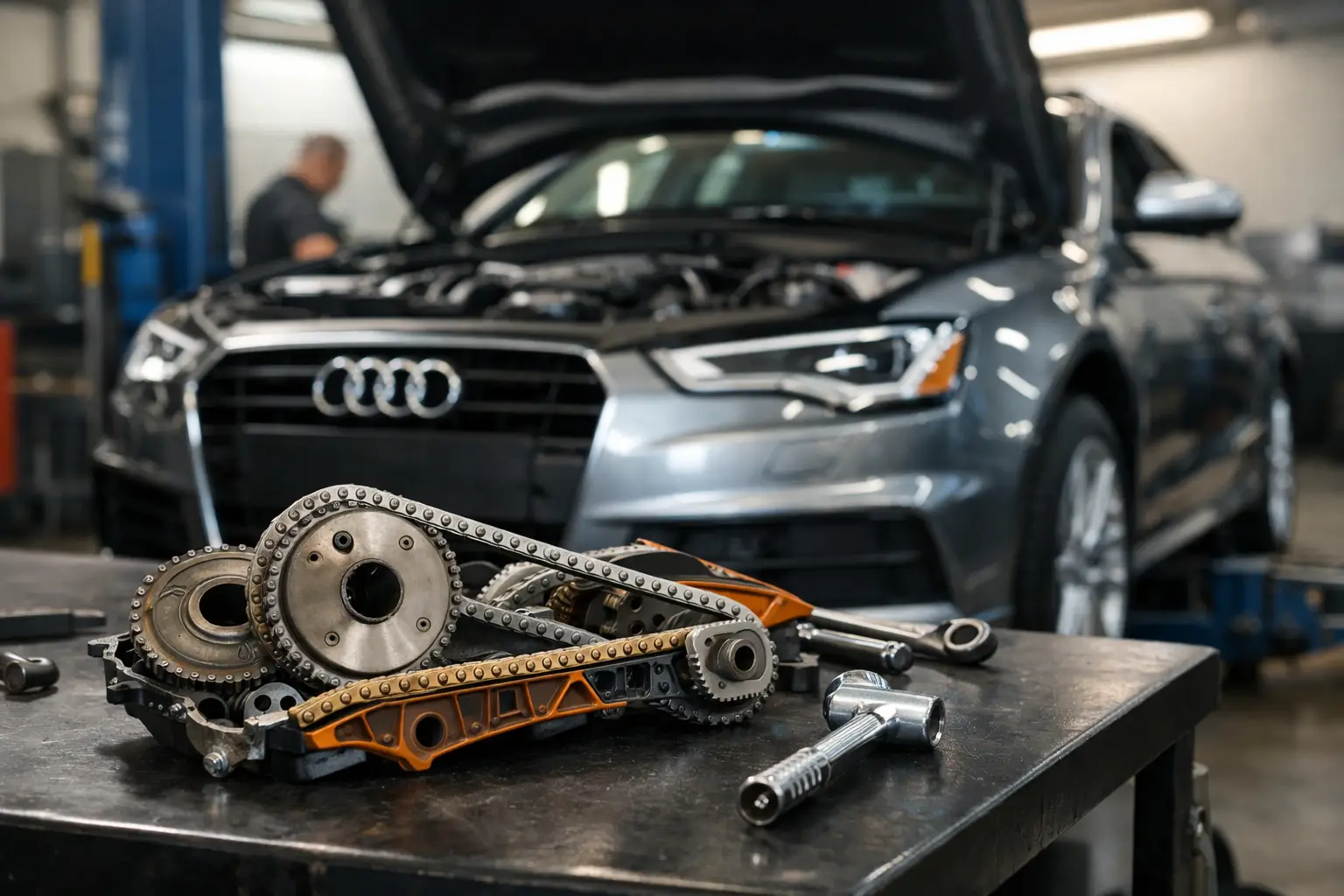
That cold-start rattle you hear for a second or two is easy to shrug off – until it turns into a check engine light, rough running, or a no-start situation. Audi timing chain repair usually starts with a symptom that seems minor, then becomes a much bigger problem if it is ignored. For Audi owners, the key is catching timing chain issues early, confirming the actual cause, and fixing the problem with the right parts and procedures.
Why Audi timing chain repair matters
Your timing chain keeps the crankshaft and camshafts synchronized so the engine can run the way it was designed to. When that timing starts to drift because of chain stretch, worn guides, or a weak tensioner, performance and reliability both suffer. In some cases, the warning signs build slowly. In others, the vehicle can go from running poorly to not running at all.
This is one of those repairs where guessing gets expensive. A noise from the front or rear of the engine does not automatically mean the chain itself has failed, and a fault code related to timing does not always point to one single part. Proper diagnostics matter because Audi engines are precise, tightly packaged, and often require brand-specific tools and scan data to pinpoint what is happening.
Common signs of timing chain trouble in an Audi
Most owners notice one of a few patterns. The first is a rattle at startup, especially after the vehicle has been sitting overnight. That can happen when oil pressure has not fully built yet and the tensioner is no longer holding the chain as firmly as it should.
The second pattern is a check engine light with camshaft or crankshaft correlation faults. You may also feel rough idle, hesitation, reduced power, or inconsistent acceleration. Some drivers describe it as the engine feeling just slightly off before any major warning light comes on.
In more advanced cases, the engine may crank longer than normal, stall, or fail to start. At that point, the problem may have moved beyond early wear and into serious timing deviation. Waiting too long can raise the risk of internal engine damage, which is exactly why early inspection is worth it.
Symptoms that should not be ignored
A brief startup rattle every now and then is still worth checking. So is an intermittent check engine light that clears and returns. European vehicles often give subtle warnings before they give obvious ones, and Audi is no exception.
If the vehicle is running poorly along with timing-related faults, it should be inspected sooner rather than later. Continuing to drive it may turn a manageable repair into a far more costly one.
What actually fails in the timing chain system?
When people talk about a timing chain problem, they are usually referring to the full timing system rather than a single broken component. The chain itself can stretch over time, but guides, tensioners, and related hardware are often part of the issue as well.
The exact failure pattern depends on the engine. Some Audi engines are known for tensioner concerns, while others may show guide wear or chain elongation as mileage climbs. Oil change history also plays a role. Clean oil at the correct intervals helps protect chain-driven systems, while neglected maintenance can accelerate wear.
This is why a proper repair is not just about replacing the one part that looks worst. A complete and informed approach addresses the system as a whole, based on inspection results, engine design, and the extent of wear already present.
Diagnosing Audi timing chain repair the right way
A good diagnosis starts with listening to the customer and confirming the symptoms. Is the noise only on cold starts? Is the check engine light on constantly or only sometimes? Has the engine been running rough, or does it still feel normal apart from the noise? Those details help narrow the direction quickly.
From there, technicians use scan tools to check stored faults, monitor camshaft timing values, and compare actual readings against specification. Depending on the Audi model and engine, additional inspection may be needed to verify chain slack, guide condition, or tensioner performance.
This is where experience with European vehicles really matters. Audi timing chain repair is not a one-size-fits-all job. The work depends on engine layout, access points, factory procedures, and accurate interpretation of test results. Replacing parts without confirming the root cause can waste money and leave the original issue unresolved.
Repair or wait? Usually, waiting costs more
There are repairs you can schedule around. Timing chain concerns are not usually in that category. If the chain system is showing early warning signs, the best time to address it is before the engine loses proper synchronization.
That does not mean every small rattle turns into a worst-case failure overnight. It does mean the risk increases the longer the condition is left alone. Once timing moves far enough out of range, drivability gets worse, warning lights become more frequent, and the chance of more extensive damage goes up.
For most owners, the practical decision is simple: diagnose it early, confirm what the engine needs, and repair it before the problem expands.
What affects Audi timing chain repair cost?
Cost depends on several factors, and this is where honest communication matters. The biggest variable is the specific Audi engine involved. Some timing chain systems are more labor-intensive because of component location and the amount of disassembly required to access them.
Parts quality is another factor. On a premium vehicle, this is not the place to cut corners with questionable components. OEM or equivalent quality parts help protect long-term reliability, especially for something as critical as engine timing.
The final cost also depends on how far the issue has progressed. Catching worn components early is usually more manageable than dealing with a vehicle that has been driven with severe timing deviation, repeated fault conditions, or a no-start complaint. That is one reason transparent inspections are so valuable. You want to know what is necessary now, what can be verified, and what the repair is intended to prevent.
Why estimates can vary
Two Audis with the same symptom may not need the exact same repair. One may need a more complete timing service because multiple components are worn. Another may show a different root cause that only appears similar from the driver seat.
A trustworthy shop should explain the findings clearly, outline what is being replaced, and answer the obvious question: why this repair, and why now?
Choosing the right shop for this repair
Audi owners already know these vehicles are not best served by guesswork. Timing chain work requires more than general mechanical ability. It calls for proper diagnostic equipment, familiarity with Audi engine designs, and a repair process that follows manufacturer standards closely.
That is where an independent European specialist often makes sense. You get dealership-level attention to the technical side, but with more direct communication, a clearer explanation of the problem, and pricing that is often more reasonable. For drivers in Palatine and the northwest suburbs, Wizard Werks is the kind of shop relationship that makes luxury car ownership a lot less stressful.
Just as important, you want a team that will tell you when a repair is needed and when it is not. Timing concerns should be taken seriously, but they should also be diagnosed honestly. That balance matters.
How to reduce the chance of future timing chain problems
No timing chain lasts forever, but maintenance habits do influence longevity. Keeping up with oil changes using the correct oil specification is one of the simplest and most important steps. Clean oil supports tensioner operation and helps reduce wear throughout the timing system.
It also helps to pay attention to small changes in how the engine sounds and starts. A startup rattle, a new fault light, or rough operation after a cold start should not be brushed aside just because the car still drives. Early action is often the difference between a planned repair and a disruptive one.
If your Audi has begun showing any of these warning signs, the smartest next step is not to hope it goes away. It is to have it inspected by a shop that knows what normal looks like, what failure patterns to watch for, and how to give you a clear answer before a small noise turns into a much bigger problem.