
That faint clunk over driveway aprons. The creak when you turn into a parking space. The rattle that seems to come and go depending on speed, temperature, or whether the car has passengers. Lexus suspension noise diagnosis usually starts with a simple question from the driver: is this normal, or is something starting to fail?
On a Lexus, the answer is rarely as simple as replacing one part and hoping for the best. These vehicles are engineered to ride quietly, so even a small amount of suspension wear can stand out. The challenge is that similar noises can come from very different sources, and misdiagnosis is where owners often lose time and money.
Why Lexus suspension noise diagnosis can be tricky
Suspension noises are deceptive. A front-end clunk may come from a sway bar link, but it can also come from a strut mount, lower control arm bushing, ball joint, or even a loose component nearby that only shifts under load. A rear creak might point to worn bushings, but it can also relate to shocks, mounting hardware, or movement in the chassis that only shows up over uneven pavement.
Lexus models add another layer because ride quality is so refined to begin with. On many vehicles, mild wear produces obvious handling problems before it creates noise. On a Lexus, the first symptom may be a subtle tapping sound with no dramatic change in steering feel. That is one reason a proper road test matters as much as the lift inspection.
It also depends on the model and mileage. An RX used for daily commuting in the northwest suburbs may develop very different suspension wear patterns than an IS or GS that spends more time on rough city streets, highway ramps, and winter-damaged pavement. The noise you hear is only one clue. When and how it happens tells the bigger story.
What the sound itself can reveal
A good Lexus suspension noise diagnosis starts with the driver’s description, but the most useful details are usually the ones people do not realize matter.
Clunking over bumps
A clunk over sharp bumps often suggests free play in a component that should stay tight under movement. Sway bar links are common suspects, especially when the noise is light but repetitive over uneven pavement. Control arm bushings and ball joints can create a heavier clunk, particularly during braking, turning, or transitions in road height.
If the sound happens mostly at low speed, that often points toward wear that shows up when the suspension is articulating more slowly and with more body movement. If it appears at both low and moderate speed, the inspection usually needs to widen beyond the obvious wear items.
Creaking while turning or parking
Creaks and groans often lead people to think something is dry, but the root cause is not always that simple. Strut mounts, bushings, and ball joints can all create creaking noises when loaded during steering input. Temperature can affect these sounds too. Rubber components often complain more in cold weather, which can make a borderline issue seem seasonal when it is really progressive wear.
Rattling on rough roads
A rattle can sound minor, but it should not be dismissed. Loose sway bar hardware, worn links, upper mounts, or deteriorated shock components can all create rattles that are easy to confuse with interior trim noise. In luxury vehicles, owners sometimes spend too long chasing a cabin sound that is actually coming from suspension movement underneath.
Knocking during braking or acceleration
When the noise changes with weight transfer, control arm bushings move higher up the list. As the suspension shifts forward under braking and rearward during acceleration, worn bushings can allow excess movement and produce a knock that is hard to duplicate by hand unless the vehicle is tested correctly.
The most common causes of Lexus suspension noise
Some patterns show up again and again, but the exact failure point still needs to be verified before parts are replaced.
Sway bar links and bushings are frequent culprits because they take a steady beating on broken pavement and potholes. They can create small clunks and rattles long before they look severely damaged.
Control arm bushings are another common source. On Lexus vehicles, worn bushings may not always look dramatic at first glance, yet they can still allow enough movement to create noise and affect ride quality. Depending on the model, this can also alter steering response and tire wear.
Struts, shocks, and their upper mounts deserve close attention as mileage climbs. A leaking shock absorber is an obvious problem, but some units create noise from internal wear or mount deterioration before visible leakage becomes severe. A vehicle can still feel relatively composed and yet make noise over low-speed bumps.
Ball joints and tie rod components can also be involved, though these tend to raise safety concerns beyond comfort. If there is confirmed looseness in a joint, the issue should be handled promptly rather than monitored.
On some Lexus models, the source may not be a worn suspension arm at all. Subframe mounts, brake hardware, exhaust contact, or underbody components can mimic suspension noise. This is where experience matters. The wrong assumption can send a car home with new parts and the same sound.
How a proper diagnosis should be done
The best process is methodical, not rushed. First comes a conversation about when the noise occurs – cold start or fully warmed up, left turn or right turn, one occupant or a full load, smooth road or rough road. Then comes a road test designed to reproduce the sound under the same conditions the owner notices.
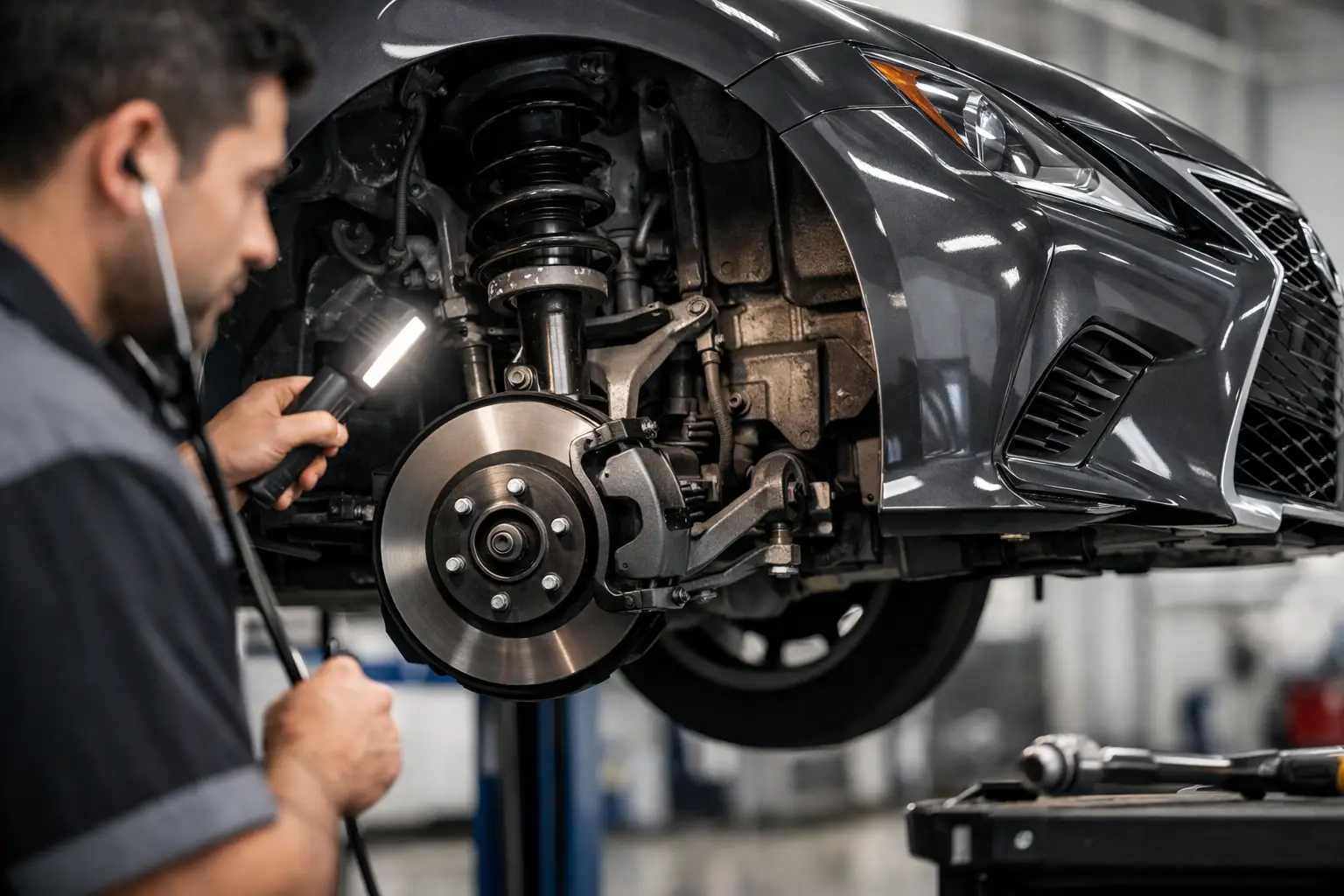
After that, the vehicle should be inspected on a lift with attention to bushings, links, mounts, joints, fasteners, and any signs of abnormal movement or contact. But visual inspection alone is not enough. Many suspension noises only show up when the suspension is loaded in a certain way, so components may need to be checked with the weight shifted or the suspension supported at ride height.
That is especially important on premium vehicles because replacing parts based only on mileage or guesswork gets expensive quickly. One noisy front corner can tempt a shop to recommend several parts at once. Sometimes that is justified, especially if multiple items are worn. Sometimes it is just uncertainty dressed up as a repair estimate. Honest diagnostics means identifying what has failed, what is aging, and what can reasonably wait.
Why guesswork costs more on a Lexus
Lexus owners usually notice suspension noise early because the cabin is quiet and the ride is refined. That is good in one sense because small issues can be caught before they lead to bigger wear. But it also means there is a temptation to throw parts at the problem in hopes of restoring the original feel.
The trade-off is straightforward. Replacing every likely component may eventually solve the noise, but it can also add unnecessary cost. Going too slowly can create the opposite problem if a worn part begins affecting tires, alignment, or braking stability. The right approach sits in the middle: diagnose precisely, prioritize honestly, and repair what the vehicle actually needs.
For owners who want a dealership-level standard without the dealership runaround, that matters. A specialist should be able to explain what they found in plain language, show where the movement or wear is coming from, and separate urgent repairs from watch-list items.
When to schedule service sooner rather than later
Not every suspension noise means the vehicle is unsafe to drive immediately, but some sounds deserve quick attention. If the noise is getting louder, if the steering feels loose, if the vehicle wanders, if you notice uneven tire wear, or if the sound is paired with a harsh or unstable ride, it is time to have it inspected.
The same goes for any knocking that happens during braking or turning. Those symptoms can point to components that affect control as well as comfort. Waiting may turn a targeted repair into a wider suspension job.
At Wizard Werks, this is exactly where a careful, brand-aware inspection makes a difference. Lexus vehicles respond best to technicians who understand how these systems are supposed to feel, not just how to replace parts when something is obviously broken.
A quiet Lexus should feel solid, composed, and predictable. If yours has started talking back through clunks, creaks, or rattles, the sound is worth listening to because the sooner the cause is identified, the easier it usually is to put the car back to the smooth, confident ride you bought it for.