
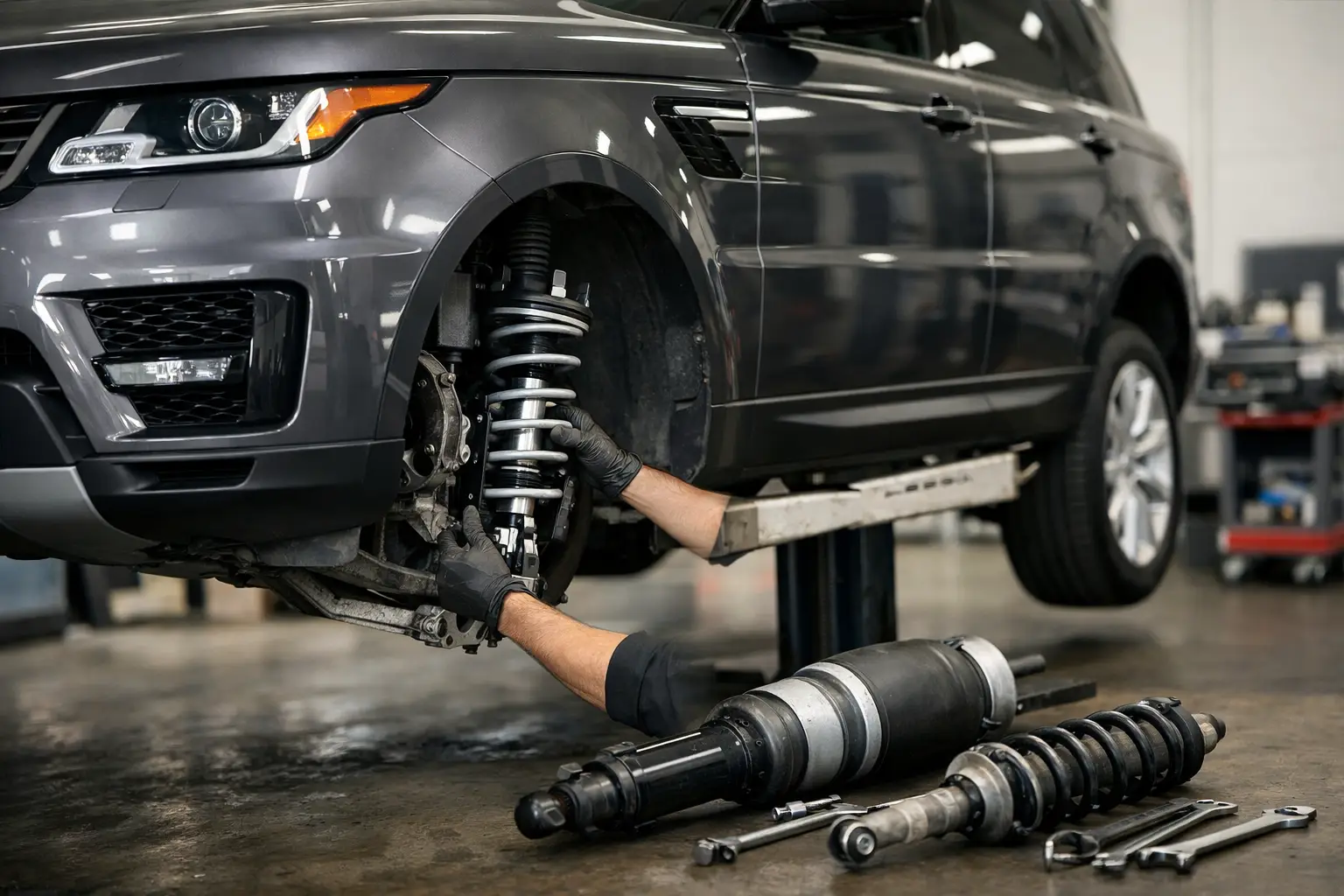
One morning your Range Rover sits lower on one corner, the ride feels harsher than usual, and a suspension warning appears before you even leave the driveway. That kind of range rover suspension repair example is common enough to feel familiar to longtime owners, but the cause is not always as obvious as it seems. Air suspension problems can come from a leaking strut, a weak compressor, a tired valve block, a height sensor issue, or a control fault that makes a healthy part look bad.
A real-world range rover suspension repair example
A typical case starts with a customer noticing the front end dropping overnight on a 2016 Range Rover Sport. The vehicle still raises after startup, but it takes longer than normal, and the compressor sounds strained. There may also be a message on the dash warning of restricted suspension performance.
At first glance, it is tempting to assume the air strut has failed and stop there. Sometimes that is exactly the issue. But on a Range Rover, replacing the first part that looks suspicious without a full diagnostic process can turn a straightforward repair into an expensive guessing game.
In this example, the vehicle arrived with three clear complaints. It sagged overnight on the left front corner, it was slow to return to standard ride height, and the ride quality had become noticeably firmer over the previous month. That combination matters because each symptom points to a slightly different part of the system.
How the suspension system is usually diagnosed
Range Rover air suspension is designed to balance comfort, handling, and height adjustment. To do that, it relies on a network of components working together: air struts, an air compressor, a valve block, height sensors, lines, wiring, and a suspension control module. If one part weakens, the rest of the system often works harder to compensate.
A proper diagnosis begins with a visual inspection and a scan of the control modules using manufacturer-grade equipment. Trouble codes can point the technician in the right direction, but they do not replace testing. A code for pressure increase too slow, for example, might suggest a failing compressor, but that same code can also appear when the system is losing air through a leaking spring or fitting.
In our example, the stored faults indicated slow reservoir fill and a left front height deviation. The next step was to measure ride height, inspect the air lines and fittings, and perform a leak test. With the suspension pressurized, soapy solution revealed a small but steady leak at the left front air strut bellows. That explained the overnight sag.
The compressor, however, was also drawing more current than expected and running longer than specification. That is a common secondary issue. When an air strut leaks for long enough, the compressor has to cycle more often to keep the vehicle level. Eventually, the leak becomes one repair and the overworked compressor becomes another.
What was actually repaired
For this range rover suspension repair example, the left front air strut needed replacement. The compressor also showed signs of wear severe enough that leaving it in place would likely bring the vehicle back with the same warning light within weeks or months. In some situations, replacing only the strut can be reasonable if the compressor still tests well. In this case, that would not have been the honest recommendation.
The repair included replacing the failed left front air strut, installing a new compressor assembly, clearing the stored faults, and recalibrating ride height. Calibration is not a minor detail. On these vehicles, new suspension components need to be matched to the control system so the vehicle sits correctly and responds as intended.
After the repair, the vehicle was road tested through several ride height changes and allowed to sit to confirm it no longer dropped overnight. Compressor run time returned to normal, the warning message stayed off, and the ride quality improved immediately.
Why these problems happen in the first place
Air suspension is one of the features that makes a Range Rover feel like a Range Rover. It gives the vehicle that composed, controlled ride owners expect. The trade-off is complexity. As the miles add up, rubber air springs dry out and crack, compressors wear down, and moisture in the system can affect valves and seals.
Climate and driving habits matter too. In the Chicago area, cold weather can make marginal leaks more obvious. A vehicle may seem fine in mild temperatures, then start sagging overnight once winter arrives. Frequent short trips can also be hard on the system because the compressor may not get ideal operating cycles, especially if it is already compensating for a small leak.
Age is often a bigger factor than mileage alone. A low-mileage Range Rover that spends long periods parked can still develop suspension issues simply because seals and rubber components degrade over time.
When a smaller repair is enough
Not every suspension warning turns into a major repair. Sometimes the issue is a height sensor linkage that has loosened or broken. Sometimes a leaking airline fitting can be resealed or replaced without changing a full strut assembly. There are also cases where the compressor relay fails and causes symptoms that mimic a compressor problem.
That is why the diagnostic process matters so much. A shop that knows these systems well should be able to explain what failed, what is still operating normally, and which repairs are urgent versus preventive. That level of transparency is especially important on European and luxury vehicles, where owners are often trying to balance long-term reliability with sensible spending.
What owners usually notice before failure gets worse
Most Range Rover suspension issues do not appear all at once. There is often a period where the signs are subtle. The vehicle may lean slightly after sitting. It may take longer to rise in the morning. You might hear the compressor more often than before, or notice the ride becoming unexpectedly stiff.
If those early signs are ignored, the system can become less forgiving. A small leak can overwork the compressor. A weak compressor can trigger warning messages and reduced ride-height function. Once the system cannot maintain pressure consistently, the vehicle may limit suspension operation to protect itself.
That is the point where a manageable repair can become more involved. Addressing the problem early usually protects more than one component.
Repair cost depends on the failed part
Owners often ask what a Range Rover suspension repair costs, and the honest answer is that it depends on what testing finds. A single leaking strut is different from a compressor and reservoir issue. A sensor problem is different from multiple leaking corners on an older vehicle.
The bigger cost mistake is not necessarily the repair itself. It is replacing parts without enough evidence, or delaying a confirmed repair until secondary damage occurs. A leaking air spring that is caught early may stay a one-corner repair. Left alone, it can shorten compressor life and increase the final bill.
For that reason, the best value usually comes from accurate diagnosis, OEM-quality parts, and proper calibration. Cheap shortcuts tend to show up later as repeat warnings, poor ride quality, or uneven height.
Why specialized service makes a difference
Range Rover suspension systems are not difficult because they are mysterious. They are difficult because they require the right scan tools, testing methods, and experience to interpret symptoms correctly. A technician has to know when a fault code points directly to the bad part and when it is only describing the effect of another failure elsewhere in the system.
That is where a specialist dealer alternative can save owners both time and money. At Wizard Werks, the goal is to diagnose the issue clearly, explain what the vehicle needs in plain language, and avoid the kind of upselling that makes luxury car service frustrating. For owners in Palatine and the northwest suburbs, that means dealership-level attention without the dealership routine.
If your Range Rover is sitting low, do not wait too long
If your vehicle drops overnight, shows a suspension warning, or starts riding differently than it used to, it is worth getting it checked before the problem spreads. Some repairs are smaller than owners expect. Others are larger, but still manageable when caught early and handled correctly.
The helpful part of any good range rover suspension repair example is not the failed part. It is seeing how a careful diagnosis leads to the right repair the first time. When your vehicle is built around comfort, control, and precision, that approach matters more than ever.
A suspension warning does not always mean the worst, but it does mean your Range Rover is asking for attention – and it usually pays to listen.