
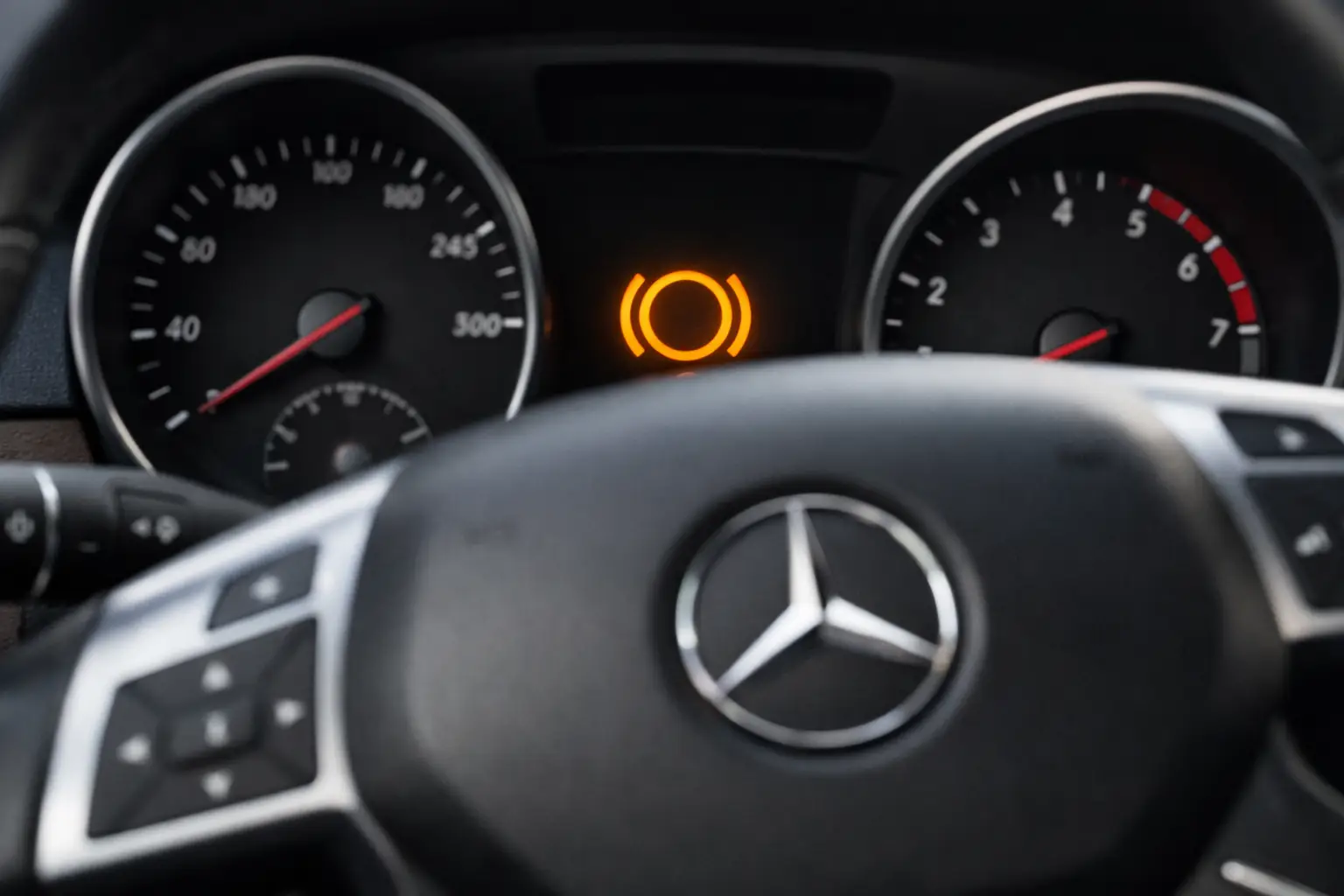
You start your Mercedes, back out of the driveway, and that Mercedes Benz ABS light stays on. Maybe the brake pedal still feels normal. Maybe another warning, like traction control or ESP, shows up with it. Either way, it is not a light to ignore, especially on a vehicle that depends on multiple braking and stability systems working together.
On a Mercedes-Benz, the ABS warning does not always mean the car has lost all braking ability. In many cases, your standard hydraulic brakes still work, but the anti-lock braking function may be disabled. That means the car can behave very differently during a hard stop, on wet pavement, or in a sudden avoidance maneuver. For drivers who expect Mercedes-level control and safety, that difference matters.
What the Mercedes Benz ABS light is telling you
ABS stands for anti-lock braking system. Its job is to keep the wheels from locking up during heavy braking. Instead of allowing a wheel to skid, the system rapidly adjusts brake pressure so you can maintain better steering control while stopping.
When the Mercedes Benz ABS light comes on, the car has detected a fault somewhere in that system. The issue could be electrical, mechanical, or related to sensor data. In some cases, the problem is isolated to ABS. In others, it overlaps with the traction control, stability control, or brake assist systems because these functions share sensors and modules.
That is why one warning light can turn into several. A failed wheel speed sensor, for example, may affect ABS, traction control, and electronic stability programming at the same time.
Can you still drive with the ABS light on?
Sometimes, yes. But whether you should drive depends on what else is happening.
If the ABS light is on by itself and the brake pedal feels normal, the vehicle may still be safe enough for a short, careful trip to a qualified repair shop. Your regular braking system may still function, but you are driving without the anti-lock protection the system is designed to provide.
If the ABS light appears with a red brake warning light, a soft brake pedal, unusual noises, or noticeably reduced braking performance, stop driving and have the vehicle inspected right away. That combination can point to a more serious brake system issue, not just a loss of ABS function.
Weather and road conditions matter too. Driving without ABS on a dry road at low speed is one thing. Driving in rain, snow, or heavy traffic is another. This is one of those situations where the honest answer is it depends. The warning does not always mean an emergency, but it does mean your Mercedes needs proper diagnostics soon.
Common causes of a Mercedes-Benz ABS warning
One of the most common causes is a failed wheel speed sensor. These sensors track how fast each wheel is rotating and send that data to the ABS control unit. If one sensor drops out, sends an implausible signal, or gets contaminated by dirt or metal debris, the system may disable itself.
Wiring issues are also common, especially on vehicles that have seen years of road salt, moisture, and temperature swings. A damaged harness, corroded connector, or intermittent electrical fault can trigger the light even when the sensor itself is still good.
Another possibility is the ABS tone ring or wheel bearing assembly. On some Mercedes models, damage or wear in these components can disrupt the sensor reading. The problem may look electrical at first, but the root cause is mechanical.
The ABS module or hydraulic control unit can also fail. This is less common than a sensor issue, but it does happen, especially as vehicles age. When that occurs, the fault often requires deeper diagnostic work because replacing parts based on guesswork gets expensive fast.
Low system voltage can play a role too. A weak battery, charging system issue, or voltage irregularity may cause multiple warning lights and communication faults. Mercedes vehicles are sensitive to electrical health, so an ABS warning is not always about the brakes alone.
Why Mercedes diagnostics matter
Mercedes-Benz brake and stability systems are more complex than many drivers realize. The ABS system does not operate in isolation. It communicates with other control units throughout the vehicle, and proper diagnosis requires more than a generic code reader.
This is where many owners lose time and money. Someone scans the car, sees a wheel speed sensor code, replaces the sensor, and the light comes right back. That happens because the code tells you where the symptom appeared, not always what caused it.
An experienced European repair specialist will look at live data, compare wheel speed readings, inspect wiring and connectors, verify power and ground, and check for stored faults in related modules. That process matters because a bad sensor, damaged reluctor ring, module fault, or voltage problem can all create similar warning messages.
For Mercedes owners, accurate testing is usually the difference between one repair and a string of unnecessary parts.
Symptoms that often show up with the ABS light
The ABS warning can come on alone, but it often brings company. You may also notice a traction control light, an ESP warning, or messages related to brake assist. Cruise control may stop working on some models. In certain cases, the speedometer may behave erratically if the vehicle is not getting reliable wheel speed data.
Some drivers notice the issue only at startup. Others see the light come and go while driving. Intermittent faults are especially tricky because they can be caused by wiring movement, heat-related sensor failure, or a component that is just beginning to fail.
Brake feel is another clue, but it is not always dramatic. The pedal may feel completely normal during everyday driving. The real difference often shows up only under hard braking, when ABS would normally pulse the brakes to prevent wheel lock.
What to expect during professional ABS diagnosis
A proper diagnostic process usually starts with a full system scan using manufacturer-grade equipment. That helps identify stored and active faults not only in the ABS module, but in other related systems that may be affected.
From there, the technician should confirm the fault rather than assuming the code points directly to the failed part. That may include checking wheel speed sensor signals, testing wiring continuity, inspecting connectors for corrosion, evaluating battery and charging voltage, and examining related components at the wheel hub or bearing assembly.
If the problem is straightforward, such as a failed sensor or damaged wiring, the repair may be relatively simple. If the fault points toward the ABS module or hydraulic unit, more testing is usually needed before any replacement recommendation is made. On a Mercedes, that extra care is worth it. These are not vehicles you want diagnosed by trial and error.
Repair costs and why they vary
Owners often ask what an ABS light repair costs, and the truthful answer is that the range can be wide. A single wheel speed sensor repair is very different from a wiring repair, and both are very different from replacing a control module.
Vehicle year and model matter. So does whether the fault is constant or intermittent. Labor time may increase if corrosion, difficult access, or multiple stored faults are involved. That is why transparent diagnosis comes first. A trustworthy shop should explain what was tested, what failed, and why the recommended repair makes sense before moving forward.
For luxury vehicle owners, that clarity matters just as much as the repair itself. You want dealership-level accuracy without paying for guesswork.
When to schedule service for a Mercedes Benz ABS light
If the light stays on, schedule service sooner rather than later. If it comes and goes, do not wait for it to become constant. Intermittent problems often get worse, and they can be harder to trace once additional faults appear.
This is especially true if you commute daily, drive in winter conditions, or rely on your Mercedes for family transportation. Your car may still stop, but the advanced braking and stability systems are there for the moments when normal braking is not enough.
At a specialized European shop, the goal should be simple: identify the real cause, explain it clearly, and fix only what is needed. That is the standard drivers should expect from a dealer alternative.
If your ABS warning has been on long enough that you have started ignoring it, this is a good time to change course. A small sensor issue is much easier to deal with than a larger safety problem that catches you at the worst possible moment.