
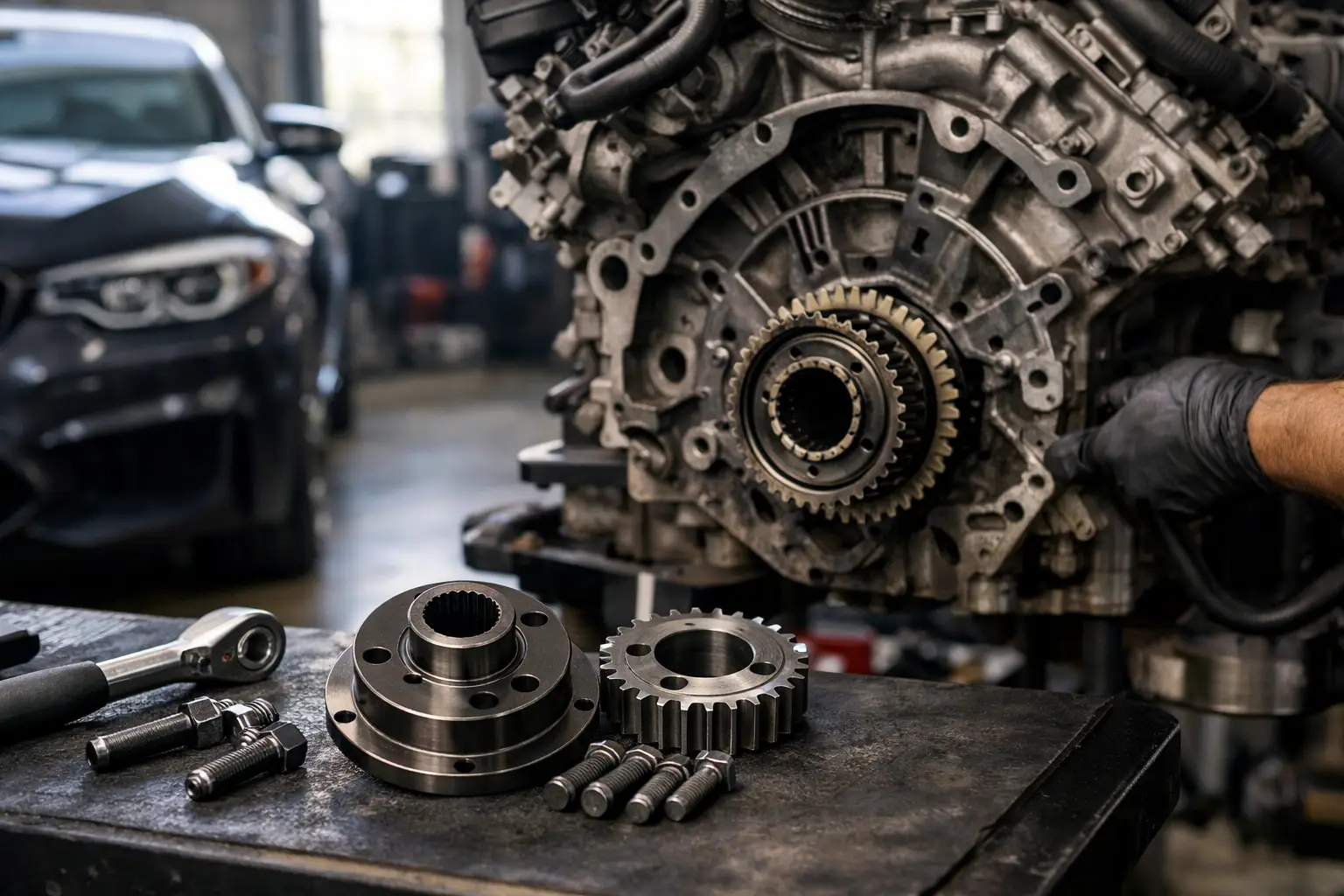
If you drive a performance-focused BMW and have heard the phrase bmw crank hub replacement, chances are it came up for a reason. This is not one of those repairs owners talk about casually. It usually enters the conversation when there are concerns about timing, drivability, or the risk of a much more expensive engine problem if the issue is ignored.
For BMW owners, especially those with turbocharged M engines, the crank hub is a small part with a very big job. It helps keep engine timing where it belongs. When it slips, the results can range from warning lights and rough running to serious internal engine damage. That is why this repair deserves careful diagnosis, clear communication, and technicians who know BMW systems inside and out.
What the crank hub does
The crank hub connects critical timing components to the crankshaft. In simple terms, it helps the engine keep camshaft timing synchronized with crankshaft rotation. That timing has to stay exact. Modern BMW engines rely on tight tolerances, variable valve timing, and precise electronic controls. When the crank hub moves out of position, the engine can no longer operate the way it was designed to.
On certain BMW models, especially high-performance applications, crank hub slip has become a known concern. Not every vehicle will experience it, and not every symptom points directly to the crank hub. Still, when timing correlation faults appear or a car suddenly runs poorly under load, it is something an experienced BMW specialist will evaluate.
Why bmw crank hub replacement matters
This repair matters because the crank hub issue is not just about one failed part. It is about protecting the rest of the engine. If the hub slips enough to throw timing off, the engine may run poorly, stall, or trigger limp mode. In more severe cases, valve timing can move far enough to create internal contact that no owner wants to deal with.
That is why guessing is a bad strategy here. Some symptoms overlap with other BMW issues such as sensor faults, VANOS problems, ignition misfires, or fuel delivery concerns. A proper diagnosis helps separate a true crank hub problem from everything else that can look similar on the surface.
Common signs you may need BMW crank hub replacement
The warning signs are not always dramatic at first. Some drivers notice a sudden loss of power, especially during harder acceleration. Others see a check engine light and find the car idling rougher than usual or struggling to start cleanly.
In many cases, the first clues show up in fault memory. Timing-related trouble codes, camshaft correlation issues, or unexplained drivability changes after spirited driving can all point technicians in that direction. On some vehicles, owners report the car felt normal one moment and noticeably off the next.
What makes this tricky is that these symptoms do not automatically confirm the crank hub has slipped. That is where BMW-specific scan tools, mechanical inspection, and technician experience matter. Replacing parts based on internet advice is expensive. Diagnosing the actual cause is what saves time and money.
Which BMW models are most often discussed
Crank hub concerns are most commonly associated with certain high-performance BMW engines, particularly the S55 found in models such as the F80 M3 and F82 or F83 M4. Discussions also come up around other BMW turbo performance platforms, especially when vehicles are modified or driven aggressively.
That said, every car has its own history. A stock vehicle that is carefully maintained can still develop issues, while a tuned car may never have a problem. Driving style, power levels, previous service quality, and overall condition all play a role. There is no honest one-size-fits-all prediction.
What causes a crank hub problem
There is usually not one simple answer. High torque loads, repeated hard acceleration, aggressive tuning, and track use can all increase stress on timing-related components. In some cases, the issue may show up on a vehicle that is not heavily modified at all.
This is where context matters. Owners sometimes assume the crank hub only becomes a concern if the car is heavily upgraded. That is not always true. On the other hand, not every performance BMW is headed for failure either. Good service advice should be based on inspection and usage, not fear.
What happens during bmw crank hub replacement
A proper bmw crank hub replacement is a detailed job, not a quick parts swap. The technician needs access to the front of the engine, the ability to lock and verify timing correctly, and the tools and procedures to reassemble everything to exact specification.
The process generally includes removing surrounding components for access, inspecting timing alignment, confirming whether slip has occurred, and replacing the crank hub assembly or related parts as needed. Depending on what the inspection reveals, additional components may need attention. Seals, bolts, gaskets, and timing-related hardware are often part of doing the job correctly.
After reassembly, timing must be verified with precision. The vehicle should then be checked for faults, drivability issues, and proper operation before it goes back on the road. This is not the kind of repair where close enough is acceptable.
Replacement versus upgrade
This is one of the most common questions owners ask. Some want to restore the vehicle to factory configuration. Others ask about upgraded crank hub solutions designed to reduce the chance of future slip, especially on tuned or track-driven cars.
The right answer depends on how you use the car. If the vehicle is a daily driver with no performance modifications, a high-quality OEM-style repair may be the most sensible path. If the car makes more power than stock or sees frequent hard use, an upgraded solution may be worth discussing.
There are trade-offs. Upgrades can offer added peace of mind, but they should be selected carefully and installed by a shop that understands BMW performance applications. The goal is not just adding parts. The goal is preserving reliability and drivability.
What affects the cost
BMW owners are right to ask for a clear estimate before approving this repair. The cost can vary based on engine type, the extent of disassembly required, whether timing has already slipped, and whether related parts need replacement.
Labor is a major factor because access and timing setup take time. Parts selection also matters. Some owners choose OEM components, while others opt for upgraded hardware. If the vehicle came in early and the issue was caught before larger engine damage occurred, the repair is usually more straightforward. If the engine has already been run with incorrect timing, the scope can change.
That is why transparent inspection is so important. A trustworthy BMW specialist should explain what has been confirmed, what is recommended, and what is optional.
Why specialist diagnosis matters
BMW engines are not forgiving when it comes to timing work. A general repair approach is not enough here. You want technicians who work with European and luxury vehicles every day, use manufacturer-grade diagnostic equipment, and understand how BMW systems behave when timing is off.
Just as important, you want honest communication. Not every check engine light on an M car means the crank hub has failed. Not every internet horror story applies to your vehicle. The right shop will tell you when the repair is necessary, when another issue is actually to blame, and what your options look like either way.
For local owners in Palatine and the northwest suburbs, that dealer-alternative approach matters. You should be able to get dealership-level technical care without feeling like you are being sold on worst-case scenarios.
When to schedule service
If your BMW has timing-related faults, sudden drivability changes, or unexplained performance loss, it makes sense to schedule an inspection sooner rather than later. Waiting may not always make the problem worse immediately, but with timing concerns, delay can raise the risk.
The same goes for owners considering preventative work on known high-risk applications. If you track the car, run added boost, or simply want a professional opinion before problems start, a conversation with a BMW specialist can help you decide whether replacement, upgrade, or monitoring is the best path.
At Wizard Werks, the goal is simple – diagnose the issue correctly, explain it clearly, and repair it the right way using quality parts and BMW-focused expertise. That gives owners what they actually want: confidence in the car, confidence in the repair, and no guessing.
If you suspect a crank hub issue, the best next step is not panic. It is getting clear answers from a shop that knows what to look for and will treat your BMW with the level of care it deserves.