
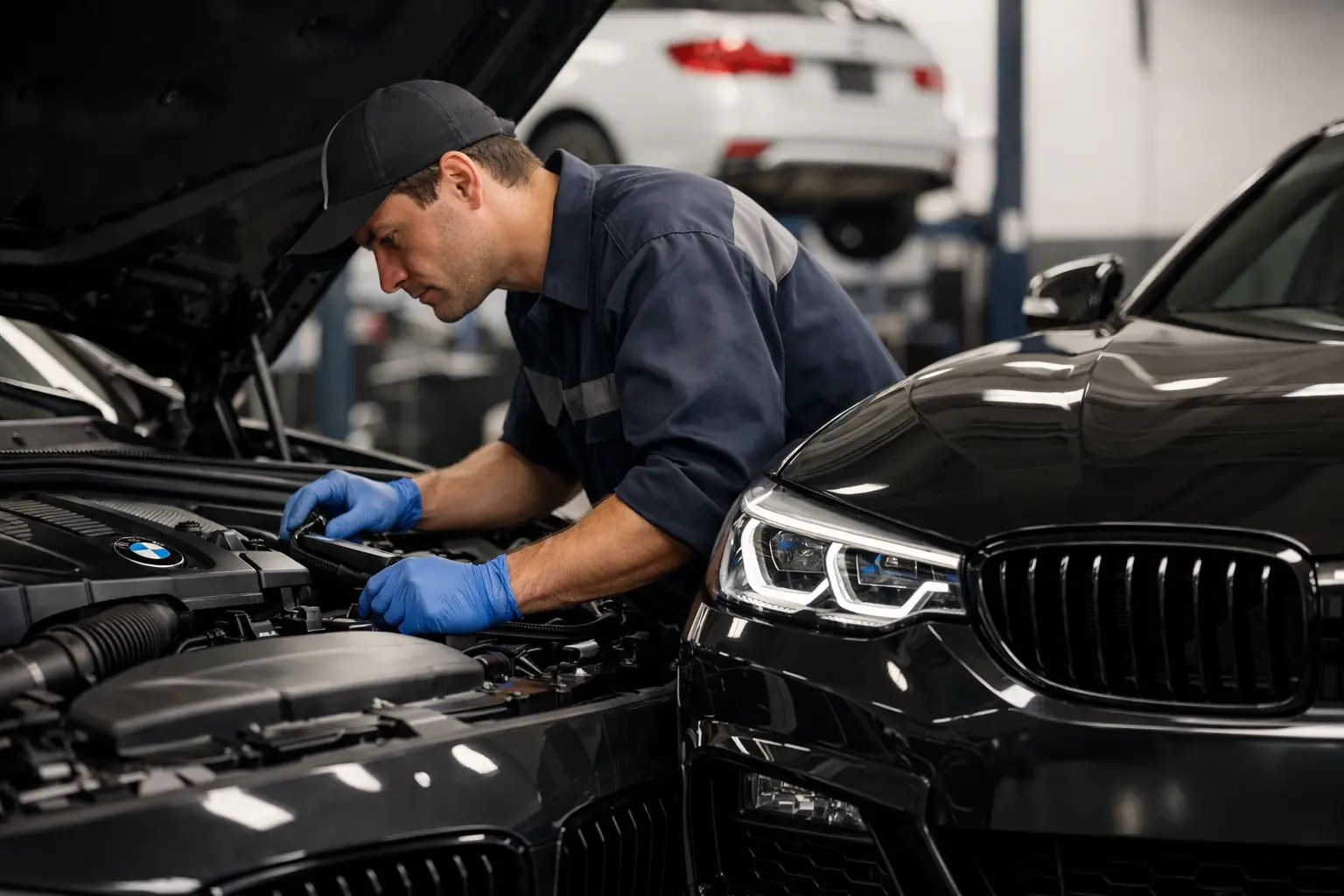
A BMW warning light is rarely a simple yes-or-no repair. The vehicle may need a scan tool that can communicate with BMW modules, a technician who recognizes a brand-specific fault pattern, and replacement parts that meet the correct specification. So, can ASE technicians service BMWs? Yes, but ASE certification should be the starting point of the conversation, not the only qualification you consider.
For BMW owners in Palatine and the northwest suburbs, the right independent shop can provide dealership-level maintenance and repair without the dealership experience or price structure. The key is finding a team that combines ASE credentials with BMW familiarity, manufacturer-grade diagnostic equipment, quality parts, and a transparent approach to recommendations.
What ASE Certification Tells You
ASE, or the National Institute for Automotive Service Excellence, tests technicians across core automotive service areas. Certifications can cover engine performance, electrical systems, brakes, heating and air conditioning, suspension and steering, and other major vehicle systems. A technician who earns ASE certification has demonstrated broad knowledge and practical competence in diagnosing and repairing modern vehicles.
That matters for BMW service. BMWs still rely on the same foundational systems found in every vehicle: brakes wear, batteries weaken, cooling systems need attention, suspension components age, and electrical faults require methodical diagnosis. An ASE-certified technician has a proven foundation for this work.
Certification also signals professionalism. It shows that a technician has invested in ongoing education and understands accepted repair procedures, safety standards, and diagnostic principles. For routine services such as oil and filter changes, brake service, battery replacement, tire-related suspension checks, and many common repairs, an experienced ASE technician can be an excellent choice.
Still, ASE certification is not the same as factory-specific BMW training. That distinction matters more as a repair becomes more diagnostic, software-dependent, or unique to a particular BMW model.
Can ASE Technicians Service BMWs Without BMW Training?
They can, depending on the job and the shop’s overall capabilities. A skilled ASE technician may have years of hands-on BMW experience, even without working at a BMW dealership. Independent specialists often build deep knowledge of recurring issues across BMW generations, from older naturally aspirated models to turbocharged vehicles, xDrive systems, plug-in hybrids, and newer models with advanced driver-assistance features.
The better question is not whether a technician has only an ASE patch on a uniform. Ask whether the technician and shop regularly service BMWs, have the correct equipment, and understand how BMW systems behave in the real world.
A general repair shop may be fully capable of basic maintenance. But BMW ownership often calls for more than general competence. A service reminder may need to be reset properly. An electronic parking brake may require service mode. A battery replacement may require registration in the vehicle’s energy management system. A warning light may involve several control modules rather than one failed component.
Without the right software and experience, a shop can still perform the physical repair but miss a required programming step, misinterpret a fault code, or recommend a part before completing the necessary testing. That is where a BMW-focused independent shop earns its value.
Why BMW-Specific Diagnostics Matter
Modern BMWs use a network of electronic modules that monitor everything from engine operation and emissions to comfort settings, chassis behavior, and safety systems. A basic universal scan tool may retrieve a generic code, but it may not access every BMW module or provide the live data needed to identify the actual cause.
For example, a check engine light could point to a fuel, ignition, air-intake, sensor, or emissions-related issue. Replacing the part named in a code is not always the right repair. A capable technician uses the code as a clue, then verifies the problem through testing, data review, and an understanding of common BMW failure patterns.
BMW-capable diagnostic equipment can also support service functions that are essential after certain repairs. Depending on the vehicle, those functions may include battery registration, brake service procedures, steering-angle calibration, electronic module coding, system adaptations, or maintenance resets. The precise requirement varies by model year and system, which is why experience with the brand is so useful.
This does not mean every BMW service requires dealer-level programming. It does mean the shop should have the ability to determine when it does. Honest service begins with knowing the difference.
The Difference Between a General Shop and a BMW Specialist
A good generalist shop may employ ASE-certified technicians and offer dependable service for many makes. That can be a practical option for straightforward maintenance. However, a BMW specialist is organized around the needs of European vehicles every day.
That focus affects more than diagnostics. It influences parts selection, repair planning, fluid specifications, maintenance intervals, and the technician’s ability to spot early signs of a known concern. BMWs are engineered with specific requirements. Using the wrong oil specification, overlooking a small cooling-system leak, or fitting a lower-quality component can create avoidable problems later.
Specialists also tend to work more efficiently because they know the vehicles. Familiarity can reduce diagnostic time and help avoid a trial-and-error approach. That does not mean a BMW repair is always inexpensive or simple. Premium vehicles use sophisticated components, and some repairs are labor-intensive. It does mean you deserve a clear explanation of what the vehicle needs, why it needs it, and what can reasonably wait.
At Wizard Werks, ASE-certified technicians pair broad technical training with the specialized diagnostics and European vehicle experience BMW owners expect. The goal is not to sell every possible service. It is to identify the right repair, use quality OEM or manufacturer-grade parts, and help customers make informed decisions about their vehicles.
What to Ask Before Scheduling BMW Service
Before choosing an independent shop, a short conversation can reveal whether it is equipped for your BMW. You do not need to know every technical detail. Focus on the shop’s process and experience.
Ask how often the team services BMWs and whether it has diagnostic equipment capable of communicating with BMW-specific systems. Ask whether the shop can perform required programming, coding, calibrations, or service resets when applicable. It is also reasonable to ask what parts it uses and whether its work is backed by a warranty.
Pay attention to how the shop answers. A trustworthy advisor should explain the work in plain language rather than hide behind jargon. They should be willing to prioritize repairs, distinguish urgent safety concerns from maintenance planning, and provide an estimate before work begins. If a diagnosis reveals additional needs, you should receive a clear explanation and approval request rather than a surprise at pickup.
For long-term BMW ownership, communication is as valuable as technical capability. The right shop keeps records, watches for trends, and helps you plan for maintenance before a small concern turns into an inconvenient breakdown.
When the Dealership May Be the Better Choice
An independent BMW specialist is not the right answer for every situation. If your vehicle has an active factory warranty concern, a manufacturer recall, or a repair covered by a BMW service campaign, the dealership may be the appropriate first call. Dealerships also have direct access to factory programs and certain proprietary resources.
For most out-of-warranty maintenance and repair needs, however, a qualified independent specialist can be a strong alternative. You can receive experienced care, personal communication, and quality workmanship while avoiding the feeling that your vehicle is moving through a high-volume service lane.
The decision comes down to the repair, the vehicle, and the shop’s capabilities. An ASE credential is meaningful. BMW-specific experience and equipment make it more meaningful.
Choose Expertise That Fits Your BMW
BMWs reward attentive maintenance and accurate diagnosis. Whether your vehicle needs scheduled service, brake work, suspension attention, electrical testing, heating and A/C repair, or help with a warning light, look for a shop that treats the details as part of the job, not an inconvenience.
The best service relationship gives you confidence before you leave the keys. Ask questions, expect straightforward answers, and choose technicians who understand both the fundamentals of automotive repair and the specific systems that make your BMW drive the way it should.