
A warning light that disappears on the way to the shop can be frustrating, but it does not mean the concern was imagined. Knowing how to prepare car diagnostics gives your technician a better starting point, reduces guesswork, and helps protect the performance and reliability you expect from a European or luxury vehicle.
For BMW, Mercedes-Benz, Audi, Porsche, Land Rover, Volvo, and similar vehicles, diagnosis is rarely as simple as plugging in a generic scanner. These cars rely on multiple control modules, brand-specific software, sensors, and systems that communicate with one another. The more clearly you can describe what changed and when it happens, the more efficiently a qualified specialist can identify the real cause.
Why preparation matters before a diagnostic appointment
Modern vehicles can store fault codes even when no warning light is currently displayed. But a code is a clue, not an automatic repair answer. A low-voltage event, intermittent sensor signal, loose connection, software issue, or mechanical concern can all trigger similar messages. Your technician must interpret the code alongside test results, vehicle history, and the symptoms you experience behind the wheel.
Preparation helps fill in the details that diagnostic equipment cannot always provide. A scan tool may show a misfire count, for example, but it cannot tell a technician that the hesitation only occurs after a cold start, during a hard merge onto Route 53, or when the air conditioning is running.
It can also prevent unnecessary work. Clear, accurate information helps a shop focus testing on the system most likely to be involved rather than replacing parts based on assumptions. That is especially valuable on premium vehicles, where correct diagnosis and OEM-quality parts matter as much as the repair itself.
How to prepare car diagnostics with useful details
Before your appointment, take a few minutes to write down what you noticed. You do not need technical vocabulary. Plain descriptions are more valuable than trying to diagnose the car yourself.
Start with the symptom. Is there a warning light, an unusual noise, a vibration, a burning smell, a slow crank, a loss of power, rough shifting, weak cooling, or an electrical feature that works inconsistently? Describe what happens in your own words and whether the condition is constant or occasional.
Then think about the circumstances. Note whether the issue occurs when the engine is cold or fully warmed up, at highway speed or in stop-and-go traffic, while braking or turning, after rain, or only after the vehicle has been parked overnight. If the concern appears at a certain speed or engine RPM, estimate the range. Even an approximation is helpful.
Also note when the problem began. Did it appear suddenly, gradually worsen, or begin after recent maintenance, a battery replacement, a tire service, or a long trip? Timing can point the diagnostic process in the right direction. A message that appears immediately after a battery issue may require a different testing path than the same message that developed over several months.
Record warning messages exactly when possible
Many luxury vehicles display detailed dashboard messages that disappear after the car is restarted. If it is safe to do so, take a photo of the instrument cluster or infotainment screen. Include any warning symbols, messages, and mileage shown at the time.
Do not clear warning lights or erase trouble codes before the appointment unless a technician specifically instructs you to do so. Clearing codes can remove valuable freeze-frame data, which records conditions such as engine temperature, speed, and load when a fault was detected. It may also make an intermittent issue harder to reproduce.
If you use an aftermarket code reader, you are welcome to share the code numbers it found. Just avoid treating those codes as a final diagnosis. A code identifies a system or condition that needs testing. It does not always identify the failed part.
Capture sounds and intermittent behavior safely
A brief video can be useful for noises, warning messages, starting concerns, or electrical behavior that may not occur at the shop. Keep it simple and safe. Have a passenger record the issue when possible, or take a video while the vehicle is parked. Never attempt to film a dashboard or engine behavior while you are driving.
For a noise, describe its character and location as best you can. Is it a click, squeal, clunk, hum, rattle, or whistle? Does it come from the front, rear, cabin, steering wheel, or under the hood? Does it change with road speed, engine speed, braking, or turns? Those distinctions help separate concerns related to the engine, suspension, brakes, steering, electrical system, or climate control.
Bring the vehicle history that affects the diagnosis
You do not need a folder full of paperwork, but recent service information is valuable. Let the shop know about work completed in the last several months, particularly repairs involving the battery, charging system, ignition components, cooling system, brakes, suspension, tires, or electrical accessories.
Mention any non-factory equipment or modifications as well. An aftermarket remote starter, dash camera, radar detector, audio equipment, performance software, lighting upgrades, or trailer wiring can affect electrical systems and diagnostic communication. This is not about judgment. It simply helps the technician understand the vehicle as it sits today.
If your vehicle has a service contract, extended warranty, or a maintenance plan, bring that information or have it available on your phone. Ask the shop about its diagnostic process and whether authorization is needed before additional testing. Transparent communication up front prevents surprises and lets you make informed decisions as findings are confirmed.
Make sure the concern can be evaluated
If possible, bring the vehicle in with enough fuel for a road test and avoid disconnecting the battery beforehand. A low fuel level can limit certain tests, while a recently disconnected battery may erase adaptive data and stored faults.
When the issue is intermittent, be honest about that. An experienced technician may need to inspect the vehicle, scan all relevant modules, review live data, and perform a targeted road test before the concern appears. Some faults are quick to confirm; others require time because the condition must be duplicated under the right conditions. Accurate diagnosis is usually less expensive than repeated repairs based on a guess.
If the car feels unsafe to drive, do not try to reproduce the problem. Severe overheating, a flashing check engine light, major loss of braking response, heavy smoke, strong fuel odor, or a warning that instructs you to stop driving calls for immediate professional guidance rather than a normal commute to the shop.
What to expect from a specialist diagnostic visit
A proper diagnostic visit begins with listening. At Wizard Werks, the goal is to understand your concern before testing begins, then explain the findings in clear terms rather than overwhelming you with code numbers.
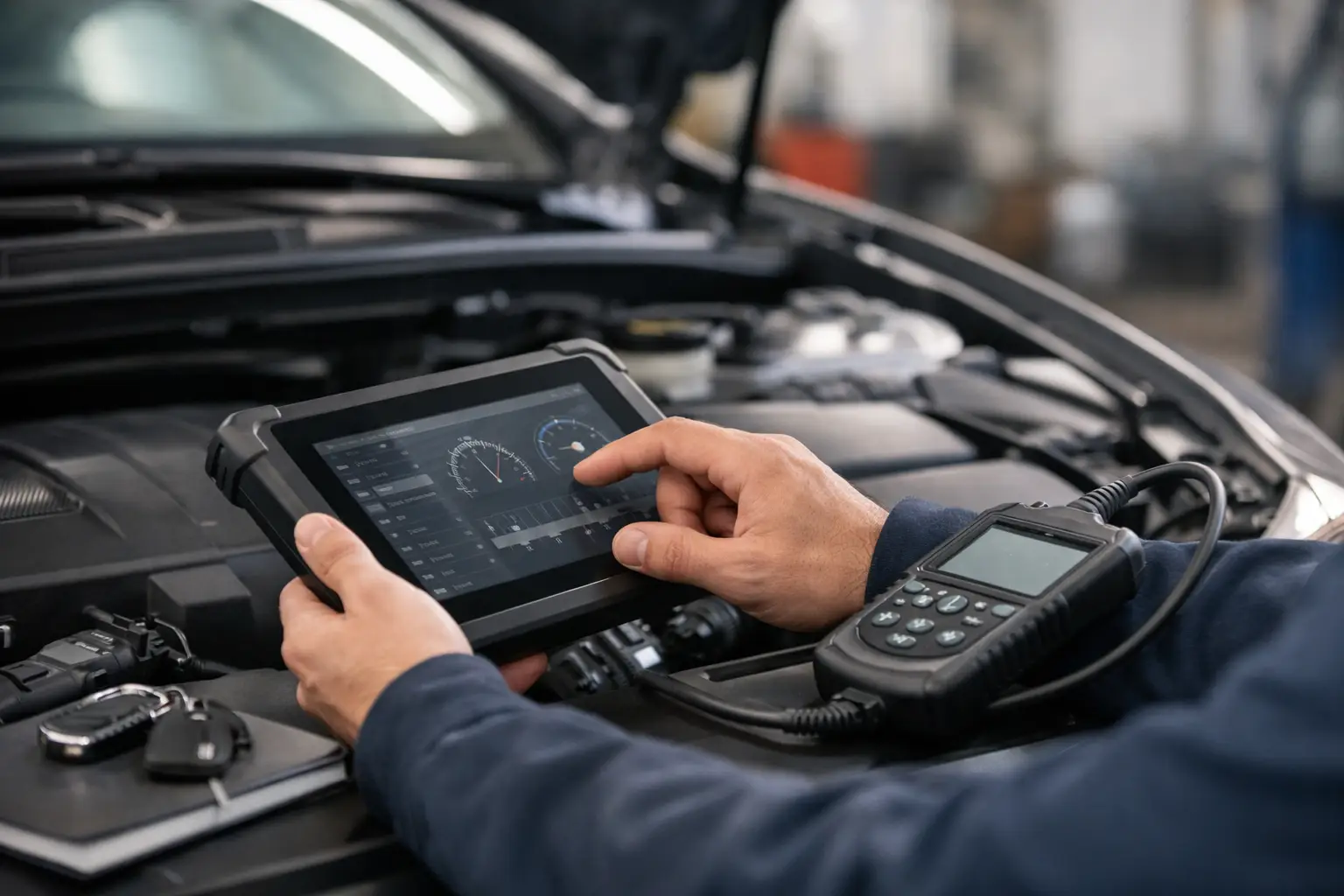
Technicians may use manufacturer-level diagnostic equipment to communicate with vehicle modules, check stored faults, review live sensor data, test circuits, inspect related components, and verify the concern through a road test when appropriate. Depending on the symptom, they may also check battery health and charging voltage, fluid condition, leaks, or visible wear that can contribute to the issue.
Once testing identifies the likely cause, you should receive a straightforward explanation of what was found, what repair or maintenance is recommended, and what can reasonably wait. Not every alert requires the same urgency. A good service advisor will distinguish between a safety concern, a reliability issue worth addressing soon, and an item to monitor.
Be ready to answer follow-up questions. A technician may ask who usually drives the vehicle, whether it is stored outside, how often it is used, what fuel is typically purchased, or whether the car has recently been exposed to severe weather. These details are part of the evidence, not an inconvenience.
A better diagnostic visit starts with a clear story
Your role is not to solve the problem before arriving. It is simply to give your technician the clearest possible picture of what the vehicle is doing, when it does it, and what has changed. A photo, a short video, and a few notes can save time while helping protect the precise driving experience that made you choose your vehicle in the first place.
When a concern appears, trust what you observed, avoid clearing the evidence, and bring the car to a specialist equipped to test it properly. That small amount of preparation can turn an uncertain warning light into a clear, confident repair plan.