
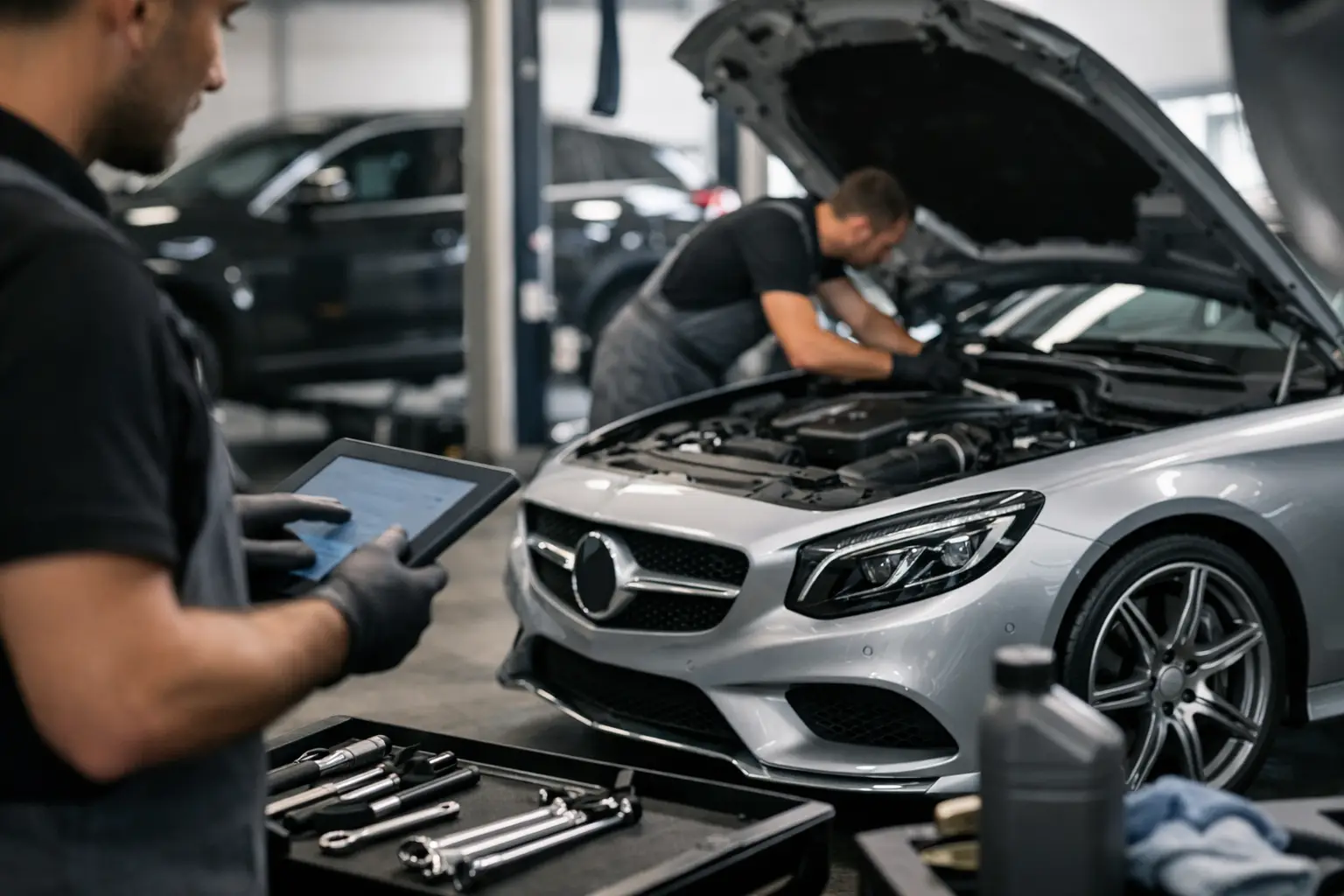
A luxury vehicle rarely gives up its smooth ride, precise handling, or quiet cabin all at once. More often, those qualities fade in small ways: a brake pedal that feels less confident, an A/C system that takes longer to cool, a warning light that appears occasionally, or a suspension that no longer feels as composed over rough Illinois roads. Knowing how to maintain luxury cars means responding to those changes early, with the right parts, equipment, and expertise.
Premium vehicles are engineered as complete systems. The engine, transmission, electronics, cooling system, suspension, and driver-assistance features all rely on precise maintenance and accurate diagnostics. A thoughtful service plan protects the driving experience you paid for while helping avoid the cost and inconvenience of preventable repairs.
How to Maintain Luxury Cars the Right Way
The best maintenance plan begins with the factory schedule, but it should not end there. BMW, Mercedes-Benz, Audi, Porsche, Land Rover, Jaguar, and other premium brands each have their own fluid specifications, inspection procedures, software requirements, and service intervals. Following those recommendations matters, particularly while a vehicle is under warranty or when you want to preserve a detailed service history.
At the same time, service intervals are not one-size-fits-all. A vehicle driven mostly on short trips through the northwest suburbs can experience more wear than one that sees regular highway miles. Winter cold, potholes, stop-and-go traffic, and long periods of sitting can all change what your car needs and when it needs it.
A qualified luxury-car specialist can help translate the manufacturer schedule into a practical plan based on your mileage, model, age, and driving habits. That approach is more useful than simply waiting for a dashboard reminder or approving every recommendation without understanding why it is needed.
Start with oil service and the correct fluids
Oil and filter service is foundational, but luxury vehicles are especially sensitive to using the proper oil grade and filter. Modern European engines often have specific manufacturer approvals that go beyond a viscosity number on a bottle. The wrong product may not cause an immediate problem, but it can compromise lubrication, performance, or long-term durability.
The same principle applies to coolant, brake fluid, transmission fluid, power steering fluid where applicable, and differential fluids. These systems are designed around exact specifications. A shop that works regularly on premium imports should identify the proper fluid for your VIN and service the vehicle according to manufacturer procedures.
If your car is driven infrequently, do not assume low mileage means no maintenance is necessary. Fluids age, moisture can accumulate, seals can dry, and batteries can weaken even when a vehicle spends most of its time in the garage.
Do not ignore small warning signs
Luxury cars communicate a great deal through their dashboards, onboard alerts, and changing behavior. A check-engine light, drivetrain message, low coolant warning, or intermittent electrical concern deserves attention before it becomes an interruption to your week.
The key is accurate diagnosis. Replacing parts based on a generic code reader or a guess can become expensive quickly, especially on vehicles with complex electrical networks and integrated control modules. Brand-specific diagnostic equipment and experienced technicians make it possible to identify the underlying issue rather than treating the symptom.
Pay attention to changes you can feel as well. New vibrations at highway speed, pulling during braking, delayed shifting, rough starts, unusual odors, coolant loss, or a clunk over bumps are all worth reporting. Clear details help a technician reproduce and diagnose an intermittent concern efficiently.
Protect the Systems That Affect Safety and Ride Quality
Luxury ownership is not only about the engine. Much of what makes a premium vehicle feel refined comes from brakes, steering, tires, suspension, and climate control. These components work hard through every Chicagoland season.
Brake service should include more than checking pad thickness. Proper inspection considers rotor condition, brake fluid age, sensors, calipers, brake hoses, and how the vehicle is stopping. Waiting until a wear indicator appears may be appropriate in some cases, but a routine inspection gives you more time to plan rather than react.
Suspension and steering deserve the same attention. Potholes, curb contact, worn tires, and normal mileage can affect alignment, bushings, wheel bearings, control arms, shocks, struts, and air-suspension components. A vehicle may still be drivable while losing the stable, controlled feel it had when new. Addressing worn components early can also protect your tires from uneven wear.
Tires should be checked for pressure, tread depth, and irregular wear at regular intervals. Use the correct tire size and load rating for the vehicle, and do not overlook alignment after a hard pothole impact or when installing new tires. Many luxury vehicles have sensitive alignment specifications, so precision matters.
Keep the battery and electronics in good condition
Electrical systems in modern luxury vehicles are sophisticated, and a weak battery can create surprisingly broad symptoms. You may see warning messages, comfort features behaving inconsistently, slow starts, or faults that seem unrelated. Before assuming the worst, a proper battery and charging-system test is a sensible first step.
If you keep a vehicle parked for extended periods, ask about a quality battery maintainer that is appropriate for your model. This can be particularly helpful during winter or for a second vehicle that is not driven daily. When replacement is necessary, some vehicles require battery registration or programming so the charging system can operate correctly.
Software updates and module programming can also be part of proper maintenance or diagnosis. They should be handled with manufacturer-grade equipment and procedures, not treated as an afterthought.
Prepare for Seasonal Demands
Illinois weather tests premium vehicles in ways that a mild climate does not. Before winter, inspect the battery, tires, wipers, brakes, coolant protection, and heating system. Make sure washer fluid is rated for freezing temperatures, and consider whether your tire setup gives you enough traction for the roads you actually drive.
After winter, schedule an inspection if you have noticed vibration, steering changes, new noises, or tire-pressure warnings. Salt, moisture, and rough roads can expose weak points in suspension, braking, and electrical systems. Spring is also a good time to test the A/C system before the first hot stretch arrives.
Summer heat places its own demands on cooling and climate-control systems. If the temperature gauge rises, the cabin does not cool as it should, or you smell coolant, do not wait for the problem to become more serious. Early testing can often narrow down the issue while repair options are simpler.
Choose Expertise Over the Cheapest Estimate
A luxury vehicle does not always need dealership service, but it does need a shop that understands its engineering. The lowest estimate can be costly if it relies on incomplete diagnostics, incorrect fluids, poor-quality parts, or procedures that overlook model-specific requirements.
Look for ASE-certified technicians, experience with your make, transparent inspection findings, and a clear explanation of what is urgent, what can be monitored, and why. OEM parts or high-quality equivalents are often the right choice, particularly for components that affect performance, reliability, or electronic compatibility. There can be reasonable alternatives in some repairs, but the decision should be informed rather than automatic.
At Wizard Werks, the goal is dealership-level care with a more personal conversation. You should know what your vehicle needs, what it can wait on, and what the repair is intended to solve before work begins.
Keep service records organized
Complete records support resale value, but their immediate value is practical. They help establish what has been done, which fluids were used, when wear items were replaced, and whether a recurring issue has changed over time. Save invoices and note any symptoms between visits, including when they occur and whether weather, speed, or driving conditions seem to trigger them.
This record is especially helpful when purchasing a pre-owned luxury car or planning to keep one beyond its original warranty. Consistent maintenance is usually less stressful and more predictable than catching up on several overdue services at once.
Luxury car maintenance is not about treating every alert as an emergency or approving work without questions. It is about working with a specialist who can separate routine care from real concerns, then help you make confident decisions. Give your vehicle that attention now, and it can keep delivering the comfort, performance, and confidence that made you choose it in the first place.