
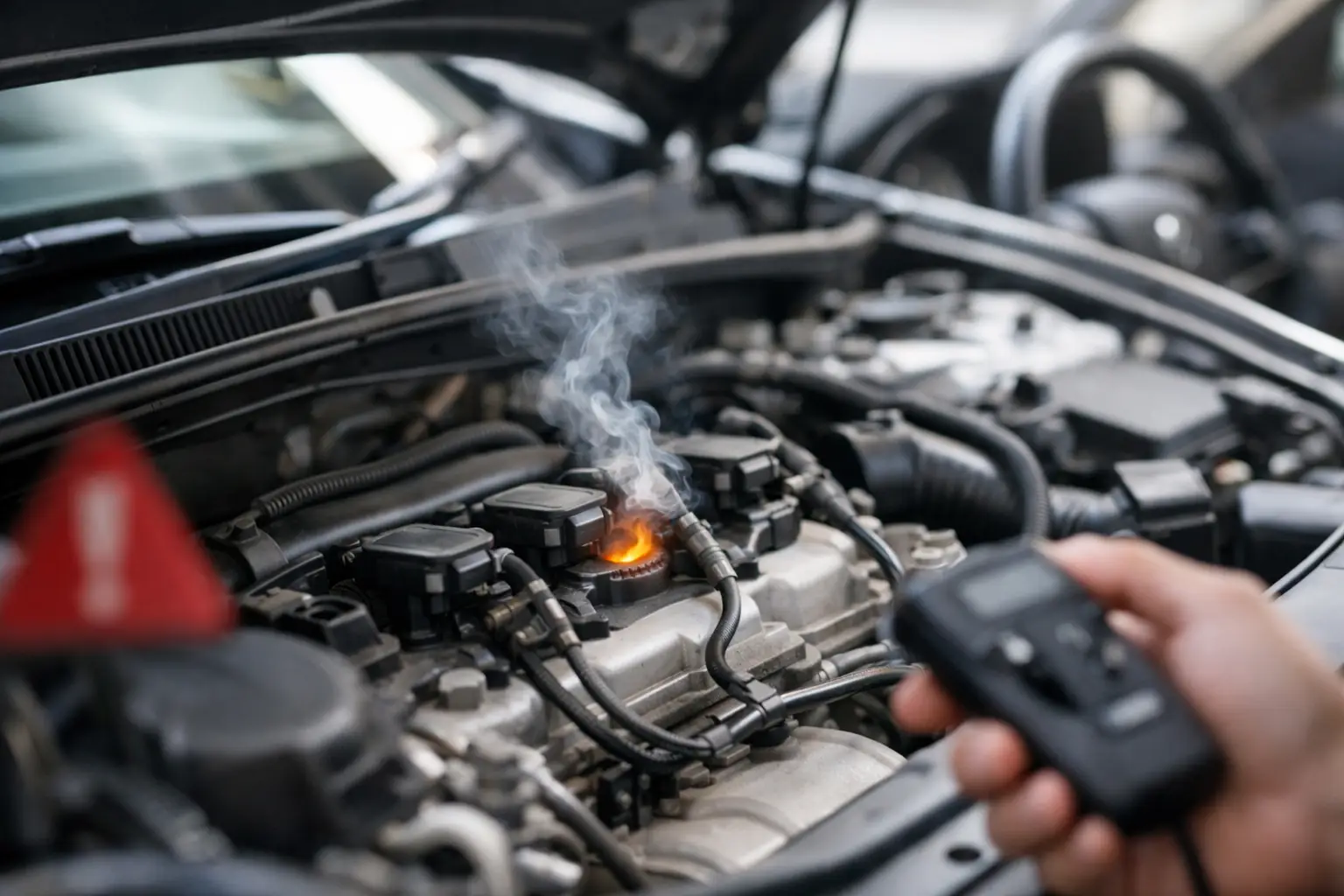
A misfire rarely starts with a dramatic breakdown. More often, it shows up on a cold morning when your BMW idles rough at a stoplight, or when your Mercedes hesitates for a second pulling onto Route 53. Those early engine misfire warning signs are easy to brush off, especially if the car still starts and drives. That is exactly why they deserve attention.
On European and luxury vehicles, a misfire is not just an annoyance. It can affect performance, fuel economy, emissions components, and overall drivability. In some cases, continuing to drive with a misfire can turn a relatively focused repair into a much more expensive visit. The key is knowing what the signs feel like and getting accurate diagnostics before the problem spreads.
What an engine misfire actually means
An engine misfire happens when one or more cylinders fail to burn the air-fuel mixture correctly. That can happen because of an ignition issue, a fuel delivery problem, an air imbalance, or a mechanical fault inside the engine. The reason matters because the symptom might feel similar across vehicles, but the fix can be very different.
On modern Audi, BMW, Mercedes-Benz, Porsche, Volkswagen, and Land Rover models, the engine management system is constantly monitoring combustion performance. When something falls outside the expected range, the vehicle may store fault codes, reduce power, or trigger a warning light. That built-in monitoring helps, but it does not always tell you the full story. Proper diagnosis still matters.
7 engine misfire warning signs to watch
1. Rough idle that was not there before
One of the most common engine misfire warning signs is an uneven idle. The car may feel shaky while stopped, the RPM may flutter slightly, or the engine may sound less smooth than usual. Luxury vehicles are designed to idle with very little vibration, so even a mild change is often noticeable.
A rough idle does not always mean a major problem. It could be something as straightforward as a worn spark plug or a failing ignition coil. But it can also point to fuel injector issues, vacuum leaks, or carbon-related problems that are more common on some direct-injection engines.
2. Hesitation during acceleration
If you press the accelerator and the vehicle pauses, stumbles, or feels like it is thinking too long before moving, a misfire may be developing. Some drivers describe it as a flat spot in power. Others say the vehicle feels briefly disconnected from the throttle.
This is especially noticeable in turbocharged European engines, where smooth power delivery is part of the driving experience. Hesitation can also overlap with fuel system or airflow problems, which is why testing is better than guessing.
3. A flashing or steady check engine light
A check engine light is not always urgent, but a flashing one usually is. In many vehicles, a flashing light means the misfire is active enough to risk damage to the catalytic converter. That is the kind of warning you do not want to ignore on a premium vehicle with expensive emissions components.
A steady light can still indicate a misfire, particularly if it appears alongside rough running or reduced performance. The light alone is not the diagnosis. It is the vehicle telling you something needs attention.
4. Jerking, bucking, or vibration while driving
Misfires are not limited to idle. Under load, they can feel like a quick jolt, a repeated shudder, or a subtle bucking sensation at cruising speed. Some drivers notice it most when climbing a hill or accelerating onto the highway.
Because European vehicles tend to isolate road noise and vibration well, these changes can stand out even when they seem minor. If the car suddenly feels less refined than it normally does, it is worth taking seriously.
5. Noticeable loss of power
A single-cylinder misfire may start small, but it still affects engine output. If your vehicle no longer feels as responsive as usual, especially during merging or passing, a misfire could be part of the issue. In some cases, the engine control system may limit power to protect the vehicle.
This can be easy to misread as bad fuel, weather, or a one-time glitch. If the loss of power repeats, gets worse, or comes with a warning light, it is time for diagnostics.
6. Poor fuel economy or a fuel smell
When combustion is not happening correctly, efficiency drops. You may find yourself filling up more often without any change in your commute or driving habits. In some situations, unburned fuel may also create a noticeable smell from the exhaust.
That does not automatically confirm a misfire, because fuel economy can change for many reasons. Still, when lower mileage shows up together with roughness, hesitation, or a warning light, it becomes a much more useful clue.
7. Hard starts or repeated starting issues
If the engine cranks longer than normal, starts roughly, or seems inconsistent from one morning to the next, a misfire-related issue may be developing. Ignition and fuel problems often show up most clearly during startup, when the system is under slightly different conditions than it is once fully warmed up.
Cold starts are especially revealing on many European models. A vehicle that smooths out after a minute can still have a real problem that needs attention.
Why misfires happen on European and luxury vehicles
There is no single cause, and that is where many repairs go off track. Spark plugs and ignition coils are common culprits, but they are far from the whole picture. Fuel injectors, intake leaks, high-pressure fuel system issues, sensor faults, carbon buildup, oil contamination, and internal wear can all contribute.
On premium import vehicles, diagnosis often requires more than pulling a generic fault code. Brand-specific scan tools, live data analysis, and experience with known failure patterns make a real difference. A misfire on a BMW turbo engine may point technicians in one direction, while the same symptom on an Audi or Range Rover may require a different testing path.
That is why parts-swapping can get expensive fast. Replacing plugs, then coils, then injectors without confirming the root cause may not solve the issue at all.
Can you keep driving with a misfire?
Sometimes the vehicle will still drive, but that does not mean it should. It depends on how severe the misfire is, whether the check engine light is flashing, and whether drivability is getting worse. A very mild symptom may feel manageable for a short trip. An active or frequent misfire can quickly lead to converter damage, reduced performance, and additional stress on engine components.
If the car is shaking heavily, struggling to accelerate, or showing a flashing warning light, it is best not to keep driving it. If the symptom is intermittent, you may still have time to address it before it becomes more serious, but that window can close quickly.
What proper diagnosis should look like
A good diagnostic process should be clear, methodical, and transparent. That means confirming which cylinders are affected, checking fault history, reviewing live engine data, and testing the likely systems instead of making assumptions. In some cases, the issue is straightforward. In others, it takes deeper analysis to separate ignition, fuel, air, and mechanical causes.
For European and luxury vehicle owners, this matters because the wrong repair can cost more than the right diagnosis. At Wizard Werks, the goal is to identify the actual cause, explain it in plain language, and recommend only what the vehicle needs. That approach saves time, avoids unnecessary parts, and helps protect the way the car is meant to drive.
When to schedule service
If you notice one of these symptoms once, keep an eye on it. If you notice two or more, or any symptom paired with a check engine light, schedule diagnostic service soon. Misfires rarely fix themselves, and waiting usually narrows your options in the wrong direction.
Owners of BMW, Mercedes-Benz, Audi, Porsche, Volkswagen, Land Rover, Jaguar, Volvo, Lexus, and other premium vehicles already know these cars respond best to specialized care. When something feels off, early attention is usually the smartest and most cost-effective move.
If your vehicle is idling rough, stumbling under load, or warning you with a check engine light, trust what it is telling you. The sooner you get clear answers, the easier it is to protect performance, reliability, and the driving experience you bought the car for.