
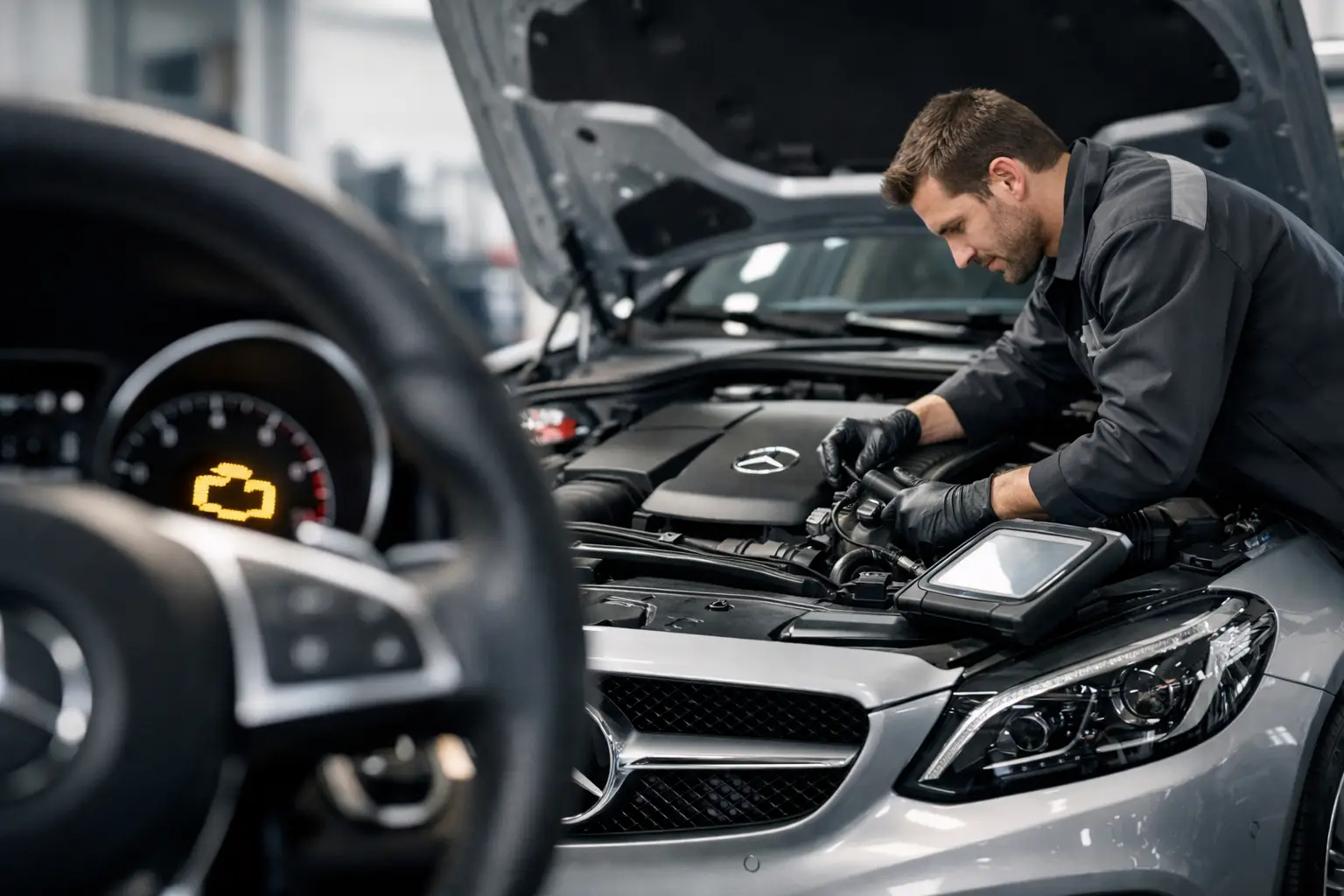
That small amber light can change the whole drive home. If you need Mercedes Benz check engine repair, the real question is not just how to turn the light off – it is why the light came on in the first place, and whether the issue is minor, urgent, or somewhere in between.
On a Mercedes-Benz, the check engine light is tied to a wide range of systems that affect performance, emissions, fuel delivery, ignition, and electronic controls. Sometimes the car still feels normal. Other times you may notice rough idling, slower acceleration, reduced power, or a transmission that does not shift quite right. The difference between a quick fix and a much larger repair often comes down to how accurately the problem is diagnosed.
What the check engine light means on a Mercedes-Benz
The check engine light is the car’s way of telling you that the engine management system has detected a fault. That fault may be stored as a pending code, a confirmed code, or a manufacturer-specific code that needs Mercedes-capable diagnostic equipment to interpret correctly.
This is where many owners get frustrated. A basic code scan might point to a broad area, but it rarely tells the whole story. For example, a fault code that mentions a lean condition or misfire does not automatically mean you need spark plugs or ignition coils. The root problem could be a vacuum leak, a failing sensor, a fuel delivery issue, or carbon buildup affecting airflow. Good diagnostics save time, money, and unnecessary parts replacement.
If the light is flashing instead of staying steady, that usually signals a more urgent misfire condition that can damage the catalytic converter. In that case, continuing to drive the vehicle is risky. A steady light gives you a little more room to plan, but it should still be checked promptly.
Common causes behind Mercedes Benz check engine repair
Mercedes vehicles are engineered to a high standard, but they are still complex machines with components that wear over time. Some check engine repairs are straightforward. Others involve a chain of related issues.
One common cause is ignition system trouble. Worn spark plugs, failing ignition coils, or uneven combustion can trigger misfire codes and drivability complaints. You may feel shaking at idle, hesitation under load, or poor fuel economy.
Another frequent issue is a vacuum or intake leak. Mercedes engines rely on precise airflow readings, and even a small leak can upset the air-fuel balance enough to trigger fault codes. This is one of those cases where replacing the wrong part based on a generic code can waste money fast.
Oxygen sensors and mass airflow sensors can also be part of the problem. These components help the engine computer adjust fuel delivery in real time. When sensor data becomes inaccurate, the engine may run rich, lean, or inconsistently. Sometimes the sensor itself has failed. Sometimes it is reporting a separate issue elsewhere in the system.
Evaporative emissions faults are another possibility. A loose fuel cap is the simple version, but there can also be leaks in the EVAP system, faulty purge valves, or other emissions-related problems that require testing rather than guessing.
On some Mercedes models, thermostat issues, crankcase ventilation faults, fuel injector problems, or timing-related irregularities may also set check engine codes. The important point is that the warning light is a symptom, not a diagnosis.
Why Mercedes diagnostics need more than a generic scanner
A lot of shops can pull a code. That is not the same as diagnosing a Mercedes correctly.
Mercedes-Benz vehicles use advanced control modules and brand-specific logic. The code itself is only the starting point. A proper diagnostic process includes reading manufacturer-level fault data, reviewing freeze-frame information, checking live sensor readings, and testing the affected system under the right conditions. In many cases, the technician also needs to know what faults commonly appear together and which one is the real trigger.
That matters because luxury vehicles are less forgiving of trial-and-error repair. Installing parts because they seem likely can get expensive quickly, especially when the original issue remains unresolved. For owners who want dealer-level accuracy without dealer-level hassle, specialized diagnostics are the smart place to start.
What to do when the light comes on
First, pay attention to how the vehicle is behaving. If the check engine light is flashing, the engine is running very rough, or the car goes into reduced power mode, it is best not to keep driving farther than necessary. If the light is steady and the vehicle feels mostly normal, you still want it inspected soon, but it may not require immediate towing.
Second, do not assume the problem is minor because the car still runs. Mercedes vehicles can compensate for certain faults for a while, which can make an issue seem less serious than it is. A small vacuum leak, weak ignition coil, or failing sensor can turn into converter damage, poor fuel economy, hard starting, or more extensive drivability issues if ignored.
Third, avoid the temptation to clear the code without testing. Resetting the light may erase useful information that helps identify the real cause. It can also delay repair while the fault returns.
How professional Mercedes Benz check engine repair works
At a qualified European repair shop, the process should feel clear and straightforward. The first step is a proper diagnostic evaluation, not a quick guess. The technician verifies the complaint, scans all relevant modules, and reviews the stored data. From there, the next step may involve smoke testing for leaks, coil and plug testing, fuel pressure checks, sensor analysis, or pinpoint electrical testing.
Once the cause is confirmed, the repair plan should be explained in plain language. That includes what failed, how it affects the vehicle, what parts are recommended, and whether anything related should be addressed at the same time. Honest communication matters here. Not every code means a major repair, and not every small issue should be postponed.
After the repair, the vehicle should be retested to confirm the fault is gone and the system is operating normally. On a Mercedes, that verification step is just as important as the initial scan. Clearing codes without validating the fix is not enough.
Repair now or wait? It depends on the fault
One of the most common questions drivers ask is whether they can wait a week or two. The honest answer is that it depends on the code, the symptoms, and the model.
A small EVAP leak may not create an immediate drivability concern, though it still should be repaired. A misfire, fuel mixture fault, or airflow issue is more time-sensitive because it can affect engine performance and emissions equipment. Some faults may also reduce fuel economy enough that waiting becomes more expensive than fixing the problem.
There is also the convenience factor. Catching a failing sensor, coil, or thermostat early is usually easier than dealing with a no-start condition or a vehicle that suddenly drops into limp mode during a busy week.
Choosing the right shop for Mercedes check engine concerns
For Mercedes owners in the northwest suburbs, the difference often comes down to specialization. You want a shop that knows European systems, uses the right diagnostic equipment, and can explain the issue without overselling. That means clear answers, quality parts, and repair recommendations based on evidence rather than assumptions.
An experienced independent specialist can often provide the same level of technical care you expect from a dealership, but with more personal communication and better overall value. That is especially important when a warning light could point to something simple, something layered, or a combination of both.
At Wizard Werks, that approach is part of the service philosophy. Mercedes owners want straight answers, accurate testing, and repairs that solve the actual problem. That is exactly how check engine issues should be handled.
When a warning light is really about peace of mind
The check engine light has a way of creating uncertainty even when the car seems to drive fine. But uncertainty is really the part that needs fixing first. Once the fault is diagnosed correctly, you can make a smart decision based on facts, timing, and budget instead of worrying about what might happen next.
If your Mercedes has started showing that light, treat it as an early conversation with your car, not just an inconvenience on the dashboard. The sooner you get a precise answer, the easier it is to protect performance, avoid unnecessary repairs, and get back to driving with confidence.