
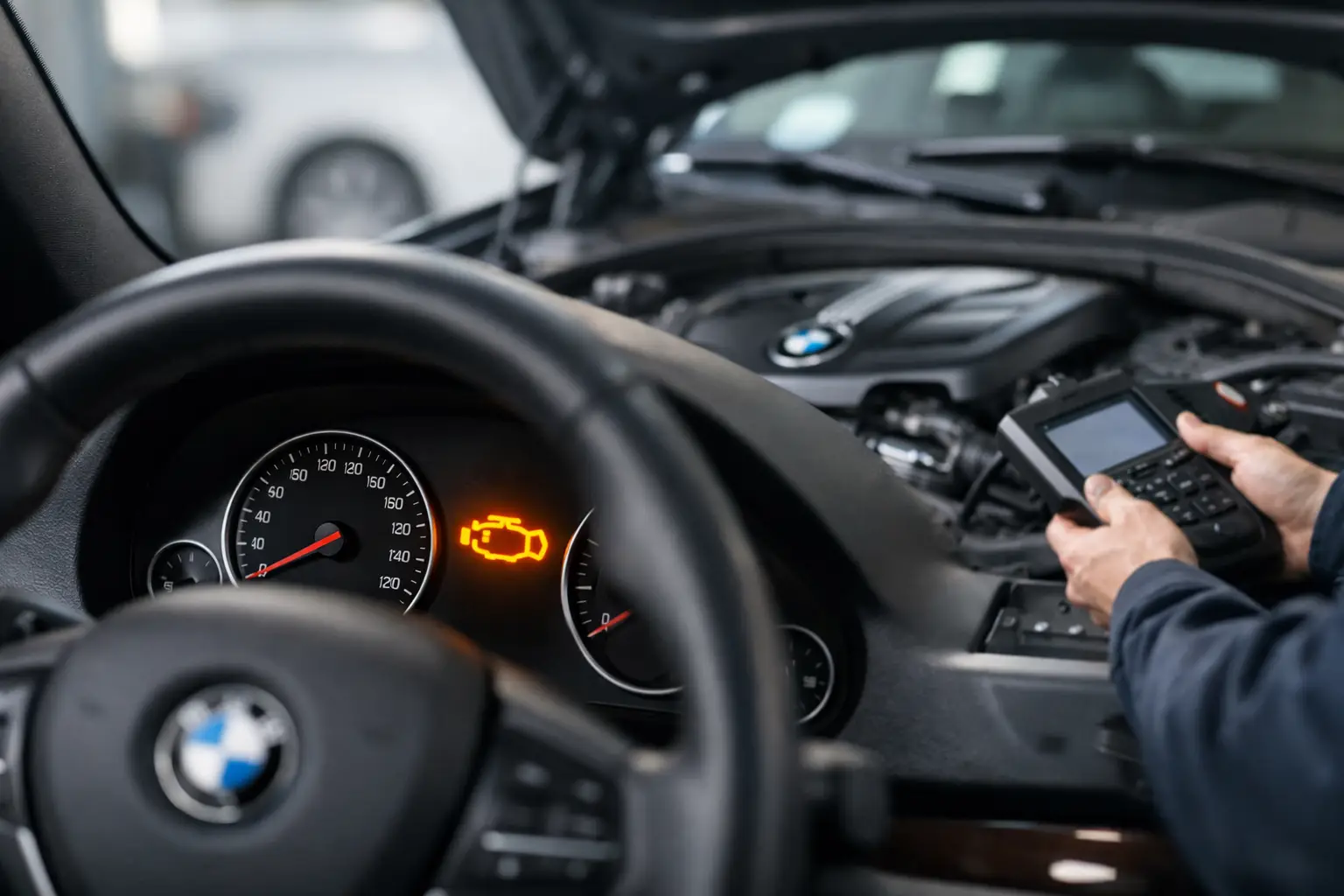
That moment when the BMW check engine light comes on is never convenient. Maybe it appears during your morning commute through the northwest suburbs, or maybe it shows up right after the car starts driving perfectly again. Either way, the message is the same: your BMW has detected a fault, and ignoring it can turn a manageable repair into a more expensive one.
The tricky part is that a check engine light does not tell you exactly what failed. It only tells you the car’s onboard diagnostics system has picked up something outside normal operating range. On a BMW, that can mean a minor emissions issue, a sensor that is reading incorrectly, or a drivability problem that affects performance, fuel economy, and long-term reliability.
What a BMW check engine light is really telling you
Your BMW is packed with sensors, control modules, and software that constantly monitor how the engine is running. When the system sees a problem, it stores a fault code and turns on the warning light. That code is the starting point, not the final answer.
This is where many owners get mixed messages. A parts-store code reader may say something broad like misfire detected or oxygen sensor fault. That sounds simple, but on a BMW, the root cause may be a vacuum leak, an ignition issue, a fuel delivery problem, carbon buildup, or wiring trouble. Replacing the part named in the code without proper diagnosis often wastes time and money.
In plain terms, the light means your car needs attention, but the severity depends on how the vehicle is behaving and what fault is stored.
Solid light vs. flashing BMW check engine light
A solid BMW check engine light usually means the car has detected a fault that should be diagnosed soon, but it may still be safe to drive for a short period if the vehicle feels normal. You should still schedule service promptly, especially if you notice rough idling, reduced power, hesitation, or poor fuel economy.
A flashing light is different. That usually points to an active misfire severe enough to damage the catalytic converter. If your BMW check engine light is flashing, reduce speed, avoid hard acceleration, and have the vehicle inspected as soon as possible. Continuing to drive in that condition can turn a smaller repair into a much larger one.
Common reasons the check engine light comes on in a BMW
Some causes are relatively minor, while others need immediate attention. The point is not to guess based on the light alone.
A loose or failing gas cap is one possibility. BMWs are sensitive to evaporative emissions leaks, and something as simple as an improperly sealed cap can trigger the warning.
Ignition problems are another common cause. Worn spark plugs or failing ignition coils can lead to misfires, rough starts, and shaky acceleration. On many BMW models, these issues can show up before the car becomes obviously hard to drive.
Sensor faults are also common. Oxygen sensors, mass airflow sensors, and other engine management components can drift out of range over time. Sometimes the sensor is the problem. Sometimes it is accurately reporting another issue.
Vacuum leaks and intake system problems can trigger the light as well. BMW engines rely on precise airflow measurements, so even a small leak can affect idle quality, fuel trims, and performance.
Fuel system concerns, including injector issues or pressure irregularities, can also bring on the warning light. In some cases, you may notice long crank times, hesitation, or reduced throttle response.
Then there are thermostat, cooling-related, and emissions-related faults that may not seem urgent at first but still matter. BMWs are engineered to tight tolerances. Small deviations in temperature, airflow, or combustion efficiency can create problems quickly if left unchecked.
Symptoms that should make you act faster
The light itself matters, but what the car is doing matters just as much. If your BMW is shaking at idle, struggling to accelerate, stalling, or entering reduced power mode, it is telling you the problem has moved beyond a simple warning.
You should also take the issue seriously if you notice a fuel smell, excessive exhaust odor, unusual noises, hard starting, or a sudden drop in fuel economy. These signs can point to faults that affect emissions, drivability, and engine health at the same time.
If the temperature is rising or multiple warning lights appear together, stop treating it as a routine service item. BMW systems are interconnected, and one fault can sometimes trigger others.
Why BMW diagnostics need more than a generic scan tool
This is where owning a premium European vehicle is different from owning an average commuter car. BMW diagnostics are highly data-driven. Reading the code is only one part of the process. You also need to evaluate freeze-frame data, live sensor readings, system adaptations, and BMW-specific fault patterns.
A generic scan tool may pull basic engine codes, but it may not show the full picture. Manufacturer-grade diagnostics can help identify whether the problem is electrical, mechanical, software-related, or caused by another component upstream. That matters because the wrong repair on a BMW is rarely cheap.
For example, a code related to an oxygen sensor may not mean the sensor itself has failed. It could be reacting to a vacuum leak, a misfire, or a fuel mixture issue. Good diagnostics prevent guesswork, unnecessary parts replacement, and repeat visits.
Can you keep driving with the light on?
Sometimes yes, but only with caution. If the light is solid and the BMW feels completely normal, you may be able to drive it briefly while arranging service. Even then, it is smart to avoid long trips, aggressive driving, or putting off diagnosis for weeks.
If the vehicle is running rough, the light is flashing, or the car has clearly lost power, driving it further is a gamble. You may get where you are going, but you may also increase damage and cost. The smarter move is to have it checked before a drivability issue becomes a breakdown.
This is one of those it-depends situations where honesty matters. Not every check engine light means a crisis. But every check engine light means the car has something to say, and BMWs tend to be expensive when that message is ignored.
What to expect during proper BMW check engine light diagnosis
A thorough diagnosis starts with a full scan of the vehicle, not just a quick code pull. From there, the technician reviews the stored faults, checks related systems, and tests the suspected cause before recommending repairs.
Depending on the symptoms, that may include inspecting ignition components, checking for vacuum leaks, testing sensors, reviewing fuel trim data, or verifying system performance under load. The goal is straightforward: identify the actual cause, explain it clearly, and fix what is needed without piling on unnecessary work.
That approach matters to BMW owners because these vehicles reward precision. You want the fault addressed correctly the first time, with the right parts and the right testing, so performance, efficiency, and reliability are protected.
How to reduce the chances of seeing the light again
No car is immune to warning lights, but regular maintenance gives you better odds. Staying current on spark plugs, oil service, filters, and scheduled inspections helps catch developing issues before they trigger a fault.
It also helps to pay attention to small changes. Rough starts, occasional hesitation, or a slightly uneven idle can all be early signs of a problem. BMWs often give subtle warnings before they give obvious ones.
Working with a shop that understands European vehicles makes a difference here. Brand-specific experience, proper scan tools, and OEM-quality parts are not extras on a BMW. They are part of maintaining the vehicle the way it was designed to be maintained.
For drivers in Palatine and the surrounding northwest suburbs, that is exactly why many turn to shops like Wizard Werks instead of defaulting to the dealership. The goal is the same high standard of care, but with more personal communication and a clearer explanation of what your car actually needs.
When your check engine light comes on, the best next step is not to panic and not to guess. Get accurate answers, fix the real issue, and give your BMW the kind of attention that keeps a warning light from becoming a much bigger interruption.