
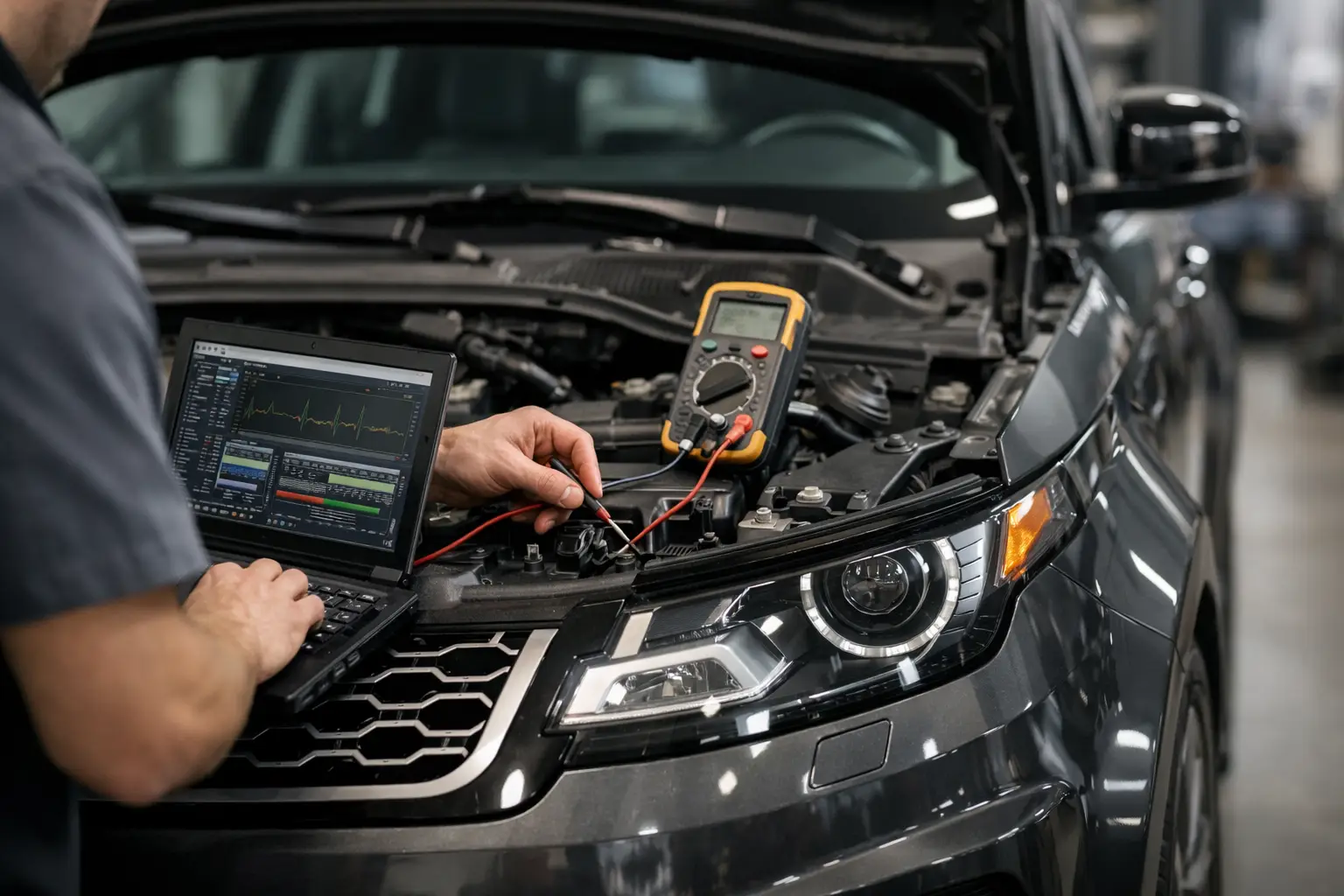
A Land Rover with an electrical problem rarely fails in a simple, obvious way. One day it may show a suspension warning, the next day the screen goes dark, a battery drains overnight, or the vehicle starts acting normally again just long enough to make the issue harder to catch. That is exactly why land rover electrical diagnostics matter. On these vehicles, guessing is expensive, and replacing parts based on a hunch usually creates more frustration than results.
Why land rover electrical diagnostics need a specialist approach
Land Rover vehicles are sophisticated, heavily networked machines. Their comfort systems, charging system, driver assistance features, body controls, lighting, infotainment, and engine management all communicate through multiple modules. When one part of that network stops behaving correctly, the symptom you notice is not always the true source of the fault.
A weak battery is a good example. Many owners assume a battery issue means the battery itself is bad, but that is only one possibility. The real cause might be a charging problem, excessive draw when the vehicle is parked, a software-related wake-up issue, water intrusion affecting a module, or damaged wiring. Without proper testing, it is easy to replace a good battery and still have the same problem a week later.
That is where brand-specific diagnostics make a real difference. A general scan tool may pull a few codes, but that is not the same as understanding how a Land Rover system is supposed to behave, which modules should be talking to each other, and whether the fault is current, stored, intermittent, or caused by a related subsystem.
Common electrical issues Land Rover owners notice first
Most owners do not walk into a shop asking for module communication analysis. They come in because something in daily driving feels wrong. Sometimes it is obvious, like a no-start condition or repeated dead battery. Other times it is a warning light that appears and disappears, power accessories that work intermittently, or strange behavior in the dash and touchscreen.
Electrical problems in Land Rover models often show up as battery drain, charging warnings, keyless entry issues, lighting malfunctions, suspension or terrain system alerts, parking sensor faults, backup camera issues, or random warning messages that do not seem connected. On some vehicles, owners notice slow cranking, erratic power window operation, or loss of communication between systems after moisture exposure.
The tricky part is that symptoms can overlap. A single fault in wiring, voltage supply, or module communication can trigger alerts in several systems at once. That does not always mean several parts have failed. It often means one problem is affecting the rest of the network.
What proper Land Rover electrical diagnostics should include
Good diagnostics start before any tools are plugged in. A technician should ask when the problem occurs, how often it happens, whether weather affects it, if the battery has been replaced recently, and whether any previous repairs were performed. That background matters because intermittent faults are often tied to heat, vibration, time parked, or recent work.
From there, the vehicle needs a full system scan with manufacturer-level or equivalent diagnostic equipment that can read Land Rover-specific data, not just generic fault codes. That scan should be paired with battery and charging system testing, review of module communication, and live data analysis where needed.
Fault codes are only the starting point
One of the biggest misconceptions about diagnostics is that a trouble code tells the whole story. It does not. A code points technicians toward a circuit or operating condition, but it still takes experience to determine whether the issue is a failed component, poor voltage, damaged wiring, a software fault, or a communication problem from another module.
For example, a code related to a sensor may not mean the sensor is defective. It may be reporting a bad input, losing reference voltage, or dropping signal because of corrosion in a connector. Replacing the sensor without testing the circuit first is not diagnostics. It is parts swapping.
Electrical testing has to go beyond the scan tool
A proper diagnostic process may also involve parasitic draw testing, voltage drop testing, fuse and relay checks, circuit tracing, connector inspection, and verification of power and ground at the affected component. On Land Rover vehicles, this is especially important because electrical faults are often intermittent and may not appear during a quick check.
If the issue is a battery drain, the technician should identify whether a module stays awake when the vehicle is supposed to go to sleep. If the concern is a communication fault, the network itself may need to be tested. If water intrusion is suspected, the inspection needs to focus on the areas and modules commonly affected.
Why intermittent faults are the most frustrating
Intermittent electrical problems can test anyone’s patience. A warning appears for two days, then disappears before the appointment. The vehicle fails to start once, then behaves normally all week. In those cases, the right shop does not dismiss the concern just because the symptom is not active at that moment.
Instead, land rover electrical diagnostics should include stored code history, freeze frame data when available, battery condition review, and inspection for early signs of wiring or module trouble. Sometimes the answer is found quickly. Sometimes it takes a more methodical process because the fault only occurs under very specific conditions.
This is where honest communication matters. Not every diagnosis can be completed in a few minutes, and not every electrical problem has a one-step fix. The right approach is to explain what has been confirmed, what still needs to be tested, and what repair path makes sense before unnecessary parts are recommended.
Dealer-level capability without the dealership experience
Land Rover owners usually already know these vehicles need specialized care. The question is where to get it. Electrical diagnosis is one area where experience, software access, and testing discipline matter more than fast assumptions. A shop that works on European and luxury vehicles every day is better positioned to recognize the common patterns and the less obvious failures that show up in these systems.
That also means understanding when a problem is straightforward and when it is layered. A failed battery may be the whole issue, or it may be the result of another problem that damaged the battery over time. A warning light may be tied to one failed module, or it may be the downstream effect of poor voltage management. It depends on the testing, not the first guess.
For owners in Palatine and the northwest suburbs, that level of clarity is often what separates a useful service visit from an expensive cycle of repeat repairs. At Wizard Werks, the goal is not to sell parts. It is to identify the actual cause, explain it clearly, and recommend the repair that fits the condition of the vehicle.
When to schedule electrical diagnostics instead of waiting
Electrical issues almost never improve with time. If your Land Rover is showing repeated warning lights, draining the battery, losing accessory functions, or acting unpredictably, it is worth having it tested before the problem leaves you stranded or affects additional systems.
Waiting can also make diagnosis harder. A weak battery can create misleading fault codes. Moisture-related issues can spread corrosion. Wiring damage can worsen as the vehicle continues to be driven. Catching the problem earlier usually means a clearer diagnosis and a more controlled repair process.
There are also cases where the symptom seems minor but points to a larger issue. A delayed start, occasional screen reset, or sporadic sensor warning may not feel urgent, but those can be early signs of voltage instability or module communication trouble. On a Land Rover, small electrical concerns have a way of becoming bigger inconveniences if they are ignored.
What owners should expect from the process
A good diagnostic visit should leave you with more than a list of codes. You should understand what was tested, what was found, what still needs confirmation if the issue is intermittent, and what repair options make sense. That transparency matters, especially with electrical work, because the value is in accurate diagnosis, not just in replacing whatever part seems most likely.
It is also fair to expect some nuance. Not every problem has a low-cost fix, and not every warning message points to a major failure. The point of careful diagnostics is to separate the two. When that process is done correctly, you avoid wasted money, repeated visits, and the stress of never knowing whether the issue was actually solved.
If your Land Rover has started doing something that does not make sense, trust that instinct. Electrical problems usually leave clues before they leave you stuck, and the right diagnostic approach can turn those clues into a clear, confident repair plan.