
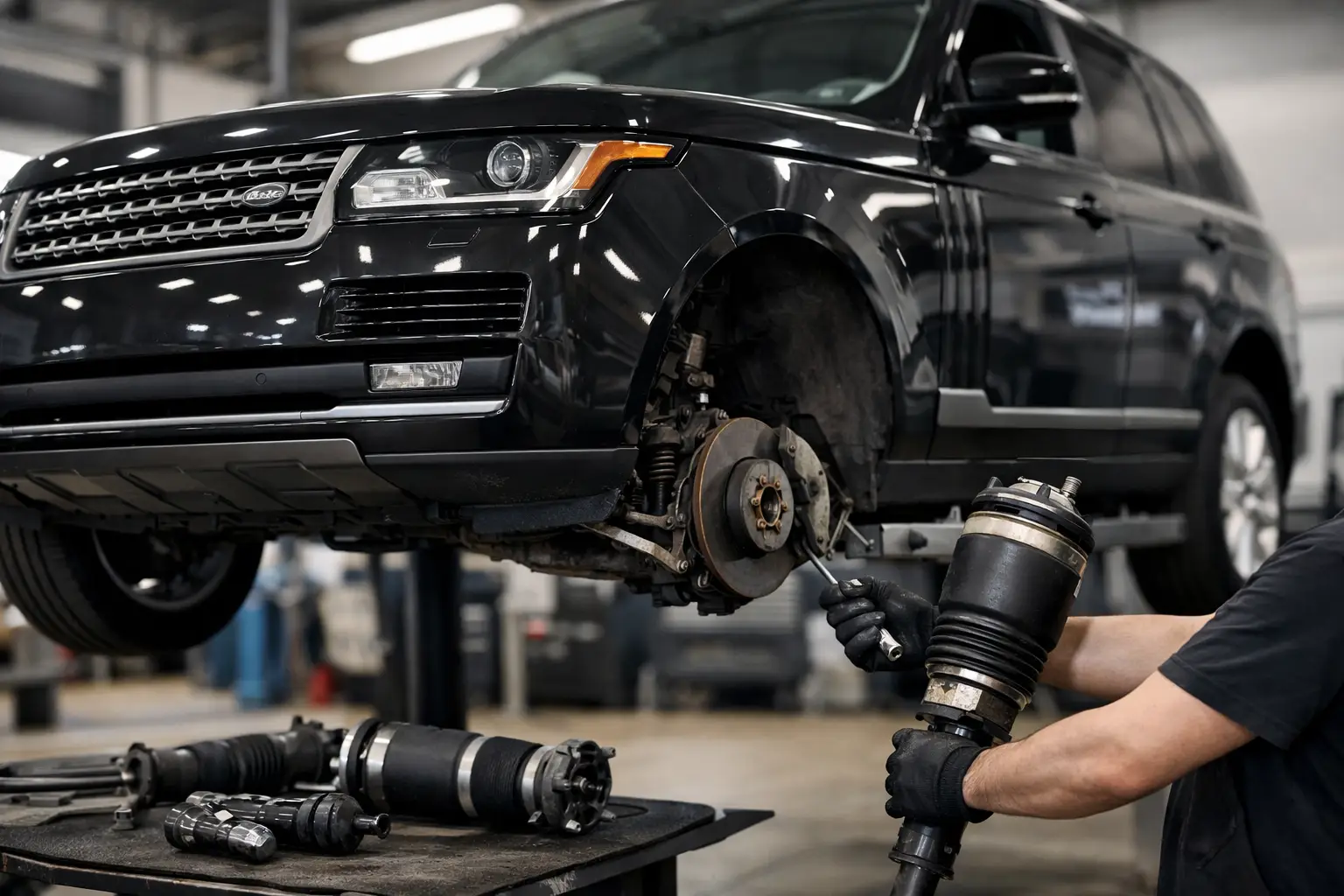
A Range Rover that starts leaning in the driveway, drops overnight, or feels unusually harsh over small bumps is telling you something. In most cases, range rover suspension repair is not a job to put off, because the air suspension system affects ride quality, handling, tire wear, and how confidently the vehicle responds on the road.
Range Rover owners usually notice the problem before a warning light says much. Maybe the vehicle sits lower on one corner after parking. Maybe it takes too long to rise when you start it. Maybe the ride has gone from controlled and composed to floaty, bouncy, or stiff. These issues can come from several places, and getting the diagnosis right matters just as much as replacing the failed part.
Why Range Rovers have more suspension complexity
Range Rover suspension systems are designed to do more than absorb bumps. They manage ride height, vehicle leveling, comfort, and handling through a combination of air struts, a compressor, valve blocks, ride height sensors, control modules, and wiring. That engineering is part of what gives the vehicle its smooth, planted feel.
The trade-off is complexity. When one component weakens, the symptoms can point in more than one direction. A sagging corner could be a leaking air strut, but it could also be a valve issue, a sensor problem, or a compressor that is no longer building pressure efficiently. Replacing parts based on guesswork often turns one repair into two.
That is why brand-specific diagnostics matter on these vehicles. The suspension system is electronic and mechanical at the same time, so the repair process has to account for stored faults, live data, pressure behavior, and how the system performs under different conditions.
Common signs you may need range rover suspension repair
Some warning signs are obvious, while others build gradually. If your Range Rover feels different but you cannot quite explain why, that is often reason enough to have it inspected.
A vehicle that sags on one side or one corner is one of the clearest indicators. If it rises after startup but settles again when parked, an air leak is very likely. If it stays low and struggles to recover, the compressor may also be overworked or failing.
A suspension warning message on the dash is another sign, but it should not be your only clue. Many owners notice excessive bouncing, nose-diving when braking, uneven tire wear, or a harsher ride before a fault message appears. In some cases, the vehicle may enter a restricted mode to protect the system.
Listen closely, too. A compressor that runs too often, sounds unusually loud, or seems to stay on longer than normal is usually working harder than it should. That often happens when the system is trying to compensate for a leak elsewhere.
What usually fails in a Range Rover suspension system
The most common issue is air strut wear. Rubber air springs age with heat, road debris, and time, and eventually they can crack or leak. Some leaks are slow enough that the vehicle only drops overnight. Others become severe and affect drivability right away.
Compressors are another frequent failure point. A compressor can wear out from normal age, but it often fails because it has been forced to run too long while trying to keep up with leaks in the system. In that case, replacing only the compressor may not solve the root problem.
Ride height sensors and valve blocks can also cause trouble. Sensors may send inaccurate readings, leading to uneven stance or improper height adjustment. Valve block issues can affect how air is distributed across the system. Electrical faults, damaged wiring, or module communication problems are less common, but they do happen and can mimic a mechanical failure.
Then there are the conventional suspension components that still matter on a vehicle with air suspension. Control arm bushings, ball joints, and related hardware can wear and contribute to noise, instability, or poor tire wear. Sometimes the complaint sounds like an air suspension problem but turns out to involve both systems together.
Why proper diagnosis saves money
This is where many owners get frustrated. They know the vehicle has a suspension problem, but they do not want to pay for unnecessary parts. That concern is reasonable.
A good diagnostic process should identify whether the issue is a leaking strut, a tired compressor, a faulty sensor, or a control issue before repairs are recommended. It should also answer the bigger question: did one part fail on its own, or did another problem cause it to fail?
For example, if the compressor is replaced without addressing a leaking air spring, the new compressor can be pushed beyond its limits. If a height sensor is out of range but worn suspension hardware is changing the geometry, replacing the sensor alone may not fully correct the issue. The right repair is not always the cheapest line item at the start, but it is usually the least expensive path over time.
What affects range rover suspension repair cost
Repair cost depends on the exact fault, the model, and how far the problem has progressed. A single leaking air strut is a very different repair from a system that has been running low for months and has now damaged the compressor.
Parts quality matters too. On a premium vehicle, suspension repairs should be done with quality components that meet the vehicle’s performance standards. Lower-grade parts can create fitment issues, inconsistent ride height, noise, or shorter service life. That is especially true when electronic calibration and ride behavior are involved.
Labor can also vary based on the need for testing, programming, ride height calibration, and whether additional worn suspension parts are found during inspection. It depends on the vehicle and the fault pattern. Honest shops explain what is confirmed, what is likely, and what can wait.
Repair now or wait a little longer?
With some car problems, waiting a few weeks may not change much. Suspension issues on a Range Rover are less forgiving.
A small air leak can turn into a hard-starting compressor and then a non-functioning suspension system. Uneven ride height can affect tire wear and handling. A vehicle that is constantly correcting itself can put extra strain on the system. If the warning signs are already noticeable, delay usually adds cost rather than avoiding it.
That does not mean every symptom is an emergency. If the vehicle still drives normally and the fault is caught early, the repair may be fairly straightforward. The key is getting it inspected before one failed component starts taking others with it.
Choosing the right shop for Range Rover suspension repair
Range Rover suspension repair is one of those jobs where specialization matters. These vehicles need more than general mechanical experience. They need technicians who understand European and luxury platforms, have access to proper diagnostic equipment, and know how to interpret system behavior instead of just replacing whatever fault code appears first.
Owners in Palatine and the northwest suburbs often want a better alternative to dealership service, but they do not want to compromise on expertise. That is a fair expectation. A qualified independent shop should be able to diagnose the issue clearly, explain the repair in plain English, and use the right parts and procedures without the dealership price structure.
That includes checking the full system, not just the failed piece. If a compressor has been overworked, you want to know why. If a corner is low, you want confirmation of whether the leak is in the strut, the line, or the valve block. If the vehicle needs calibration after repair, that should be part of the process, not an afterthought.
At Wizard Werks, that approach is simple: diagnose accurately, explain honestly, and repair what the vehicle actually needs. For Range Rover owners, that usually means fewer surprises and more confidence in the result.
What to expect after the repair
When the repair is done correctly, the difference is usually immediate. The vehicle should sit at the proper height, respond consistently, and return to the composed ride Range Rover owners expect. You should not hear the compressor cycling excessively, and you should not wonder whether the vehicle will be leaning again by morning.
It is also worth asking about the condition of the rest of the suspension system while the vehicle is being inspected. On an aging luxury SUV, it is not unusual to find that one major fault has been masking smaller wear items. That does not always mean everything should be replaced at once. It does mean you deserve a clear picture of what is urgent, what is developing, and what can be planned for later.
If your Range Rover has started riding lower, feeling rougher, or showing suspension warnings, trust the change in behavior. Catching the problem early usually gives you more repair options, better value, and a much easier ownership experience going forward.